


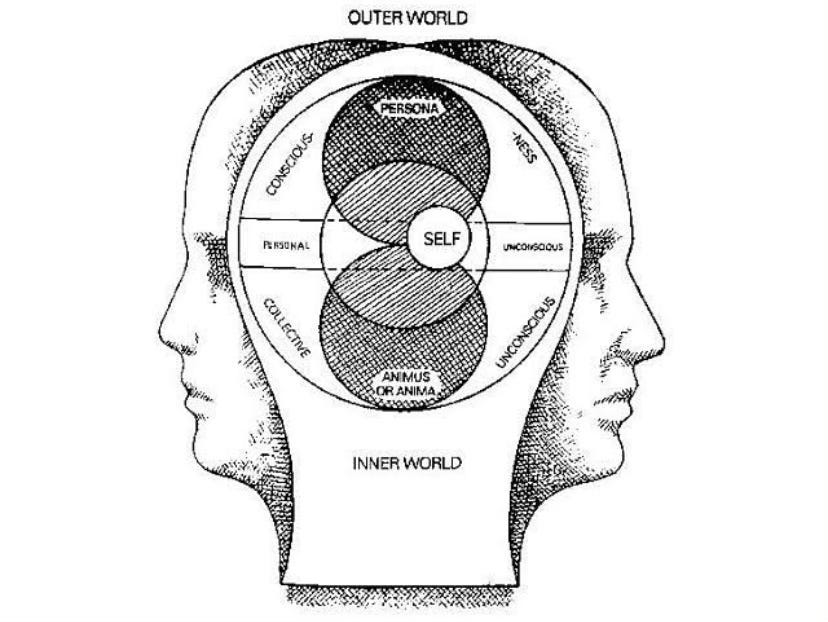
Most people have at the very least a vague understanding of what the unconscious mind represents. Even so, the vast majority of us seriously underestimate its scope. The unconscious mind is the largest part of our mental real estate. It is a boundless collection of feelings, desires, memories, repressed thoughts, and cognitive processes that take place below the level of conscious awareness. Despite his countless skeptics, Freud’s discovery of the unconscious mind was undeniably groundbreaking. He exposed that we all walk through life, forming & severing connections, all while the largest portion of our mental contents is almost entirely inaccessible to us. It begs the question: are our choices ever truly our own?
The function of our unconscious is clear as it is invariably asking the exact same question in every situation: Am I safe? The complications arise when the unconscious attempts to answer that question while having a very hazy awareness of the external world and what’s actually taking place around us. The conscious mind makes logical decisions based on direct information from our environment received through our senses (sight, smell, sound, touch), the unconscious mind does not. As a result, the conscious mind is able to easily and precisely distinguish, for example, our husbands or wives from our parents, or our siblings from our colleagues. The unconscious cannot and instead sorts people into more or less one of six fixed categories: (1) a person to nurture, (2) a person to be nurtured by, (3) a person to mate with, (4) a person to run away from, (5) a person to submit to, or (6) a person to attack. Later on in the cognitive processing the subtitles of ‘neighbour’, ‘cousin’, ‘wife’, ‘mother’ or ‘enemy’ are assigned.
How it all works
To demonstrate the cognitive interplay between both, here is a practical example:
Let’s say someone knocks on your door, you go to answer it and it’s an old friend from work. Your conscious mind will immediately screen this individual using your senses and send the screening to your unconscious mind for scrutiny. The unconscious receives the image and compares it with other stored images, memories, and feelings. Immediately, it produces a conclusion that this human being is not a stranger. A millisecond later there is a second observation—there are no dangerous episodes associated with this image. Another millisecond later—there have been numerous pleasurable episodes associated with this image. A conclusion is reached—this image is of a nurturing safe person. The next thing you know you are already involuntarily moving towards the individual to embrace them because your unconscious has sent a signal to your brainstem and then when operating with your conscious brain you decide to greet her with a “Hi! How are you?”
That entire sequence of events has taken place outside of your awareness in a fraction of a second in your unconscious mind. It’s truly incredible! To make sense of this in the context of marital conflict, let’s take a look at a more marriage-related example.
Let’s say you’re a 35-year-old married woman at home thinking warm loving thoughts about your charming husband and you decide to call him and share your sentiments. You ring his number and his secretary answers to tell you he’s out of office and cannot be reached right now. Your heart sinks. Suddenly the warm loving thoughts disappear entirely and you feel a surge of anxiety and perhaps rage: Where is he? How could he be too busy for me? Your conscious rational mind knows all too well that he’s probably calling a client or eating lunch but another deeper more vulnerable part of you feels abandoned or rejected. You are an intelligent and capable woman and after the simple fact that your husband was not available the first time you rang him, you now feel exactly as vulnerable as perhaps you did when your parents left you alone with an unfamiliar babysitter weekends at a time. Your unconscious mind is frozen in time.
Everything that was, still is
Our unconscious mind has absolutely no sense of linear time. Today, tomorrow, and yesterday do not exist to your unconscious. Everything that was, still is. This can help us to understand why sometimes the feelings we experience within marital conflict seem alarmingly out of proportion to the events that triggered them. The entirety of your emotional history as a human being resides in your unconscious mind including the experiences that hurt us most. We naturally make associations between the details of our negative experiences and the resulting negative emotional responses. Those associations also reside in our unconscious mind. Hence, when a vaguely similar experience occurs in our marriage, the associated emotional response is elicited despite how inappropriate it is in relation to the actual current experience that triggered it.
From my personal and professional experience, this becomes most evident in the way our attachment patterns (formed in early childhood) interact and shape our relationships in adulthood. Psychologist John Bowlby, and later Mary Ainsworth, proposed that our early interactions with caregivers create a relational internal working model—an unconscious blueprint that dictates how we seek, maintain, and respond to intimacy. These theories were investigated in experiments involving observing children react to a temporary separation from their mothers. Three primary attachment styles were observed: Secure attachment, Anxious attachment, and Avoidant attachment. When unresolved attachment wounds are triggered in marriage, our unconscious mind reacts not to the present moment, but to echoes of the past. An anxiously attached individual, shaped by inconsistent caregiving, may experience overwhelming fear at any sign of emotional distance, while an avoidantly attached partner, who learned to equate closeness with intrusion, may instinctively withdraw. Neither response is truly about the current relationship; instead, both are unconscious reenactments of early relational wounds, playing out in ways that feel inevitable but are, in fact, deeply ingrained patterns.
When we enter romantic relationships our unconscious interact with our partner’s unconscious and provoke their attachment patterns. This often creates a dynamic where partners unknowingly trigger each other’s deepest wounds and fears. What we seem to hope for when we attach to someone new is a peculiar paradox. On the one hand, we are seeking in our partner the qualities of who we were attached to as children. On the other hand, we demand that our lover correct the wrongs that this early attachment inflicted upon us. We attempt to return to the past but simultaneously we attempt to undo the past. A particularly gruelling dynamic of this kind is the relationship between an Anxiously attached individual and an Avoidantly attached individual.
Take Sara, an anxiously attached individual whose mother was emotionally inconsistent. At times her mother was loving, present, and affectionate, but at other times she would withdraw and become cold—emotionally distant. Sara felt interchangeably loved and rejected. As a result, Sara developed an unconscious pattern of seeking constant reassurance and closeness in relationships, fearing that any emotional distance meant rejection. When Sara married Adam, she was unconsciously drawn to him, identifying elements of her mother in him and simultaneously seeking in him the stability and emotional presence that her mother didn’t provide.
Adam has an avoidant attachment style. He was raised in a traditional Arab family where emotional expression was stifled, and his father often dismissed his feelings, teaching Adam to contain and suppress his emotions and maintain a sense of independence. For Adam, emotional intimacy feels unfamiliar and suffocating, and closeness is something foreign that may strip him of autonomy. In his marriage to Sara, he finds himself withdrawing when she seeks emotional closeness.
Their dance looks something like this: Sara seeks reassurance that Adam loves her and still wants her (‘Do you love me?’); Adam withdraws feeling a little uncomfortable with emotional intimacy; his distance triggers Sara who reaches closer to Adam to be reassured she is still loved; Adam pulls away further feeling suffocated and controlled; Sara’s deepest fears of rejection are triggered and the cycle continues.
Awareness is their only hope at breaking this feedback loop. The conscious mind’s biggest roles is to moderate the involuntary reactions of the unconscious mind but it cannot do this without awareness. Without a conscious and informed effort to make the contents of your unconscious mind more accessible to you for confrontation and scrutiny, your behavioural and emotional reactions during marital conflict may remain entirely out of your control. It is only when they begin to unpack these unconscious dynamics—through deep introspection, journalling, therapy, and open & honest disclosures—that Sara and Adam can begin to break free from this cycle. With awareness, they can start to understand why they react the way they do and work toward building a relationship that is not driven by the emotional patterns of their childhoods, but by conscious choice and mutual understanding.
References
Ainsworth, M. D. S., Blehar, M. C., Waters, E., & Wall, S. (1978). Strange Situation Procedure (SSP). PsycTESTS.
Bowlby, J. (1978). Attachment theory and its therapeutic implications. Adolescent Psychiatry, 6, 5–33.
Freud, S. (1915). The Unconscious (Standard Edition, vol. 14, pp. 159-190). London: Hogarth.
Amazing 👏🏻👏🏻
That’s a great one. The unconscious mind can control almost everything in our actions. Many people saw the unconscious mind as a muscle that can be developed or exercised based on the picture of ourselves we want.