


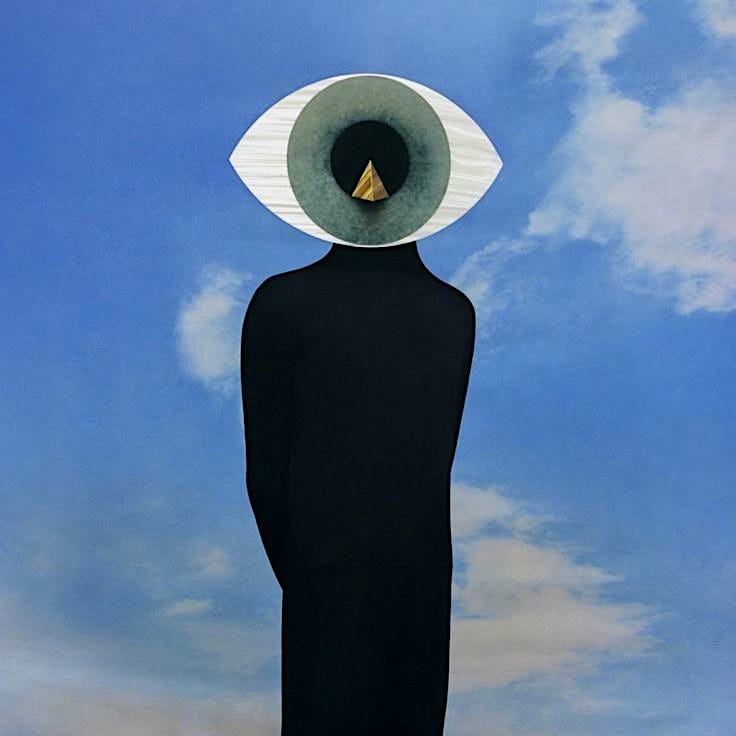
In the unfolding drama of our lives, we are both the actor and audience, experimenter and observer, protagonist and spectator. We become immersed in the theatre of our own thoughts, emotions, and actions and those of everyone around us. But what if, for just a moment, we could step outside of ourselves? What if we could bear witness to the complexity of our inner world as a stranger, a silent but analytical observer? Could we unlock a new level of self-mastery?
I have been attempting this intellectual exercise of watching myself like a stranger in various social settings. It’s a little tedious and requires a moment of disconnection and detachment from the immediacy of my imminent personal experience but I feel it has facilitated the construction of some extended cognitive real-estate for me. I have a new mental arena free from the biases, narratives, and emotional entanglements that would typically dominate my consciousness. It manifests in my mind as a series of rather invasive questions; What am I avoiding here? What am I seeking here? What am I interested in so that I will spontaneously pursue it? What am I procrastinating, and why? What motivated me to say yes to this? What am I trying to control here? Where and when have I felt like this before? Why did that irritate me? Embarrass me? Persuade me? Fatigue me? Charm me? Enrage me?
I must confess, I am rarely able to immediately answer any of that. However, I have found that questions asked to oneself with intimate curiosity refuse to remain unanswered and eventually, I will find that my cognitive real-estate has once again expanded with new insight. It is as though, with every attempt to step outside of myself, I am building another intellectual bridge between the intentional and instinctive, the conscious and unconscious. I am forced to confront the unchallenged assumptions about myself and others that often dictate my life. It’s not always pleasant. In fact, it’s frequently unnerving. But discomfort, as we all know, is a necessary precondition for growth.
An unexpected finding of this exercise has been my increased capacity for empathy. When you interrogate yourself and begin to see your own contradictions, blind spots, hypocrisies, and vulnerabilities with clarity, you start to assume they exist in others too. As a species, we are notorious for holding our peers to a moral and social standard above our own. Fundamental attribution error is a cognitive bias that the vast majority of us carry into every single social relationship. It is the acknowledgement of my own complexity and nuance but an inability to offer others the same understanding. I am elaborate and complex, but you are simple. If I am in a bad mood and yell at my partner it is a result of a plethora of contextual factors; there was traffic on the way home, I have late assignments due at work etc, but if my partner is in a bad mood and yells at me it is because they are rude. It is not so much narcissism as it is the default human condition. We are profoundly judgemental creatures. The irritation in a colleague’s tone, the silence from a friend, it all begins to seem less like a personal affront and more like the natural byproducts of the complex machinery of being human. It’s humbling, really, to see how alike we all are beneath the surface.
In practise, the concept (of watching yourself like a stranger) is a paradoxical one. On the one hand, it requires you to step away from yourself, to look at your life as if it were a novel or a film, to disentangle from the narrative in which you are the main character. On the other hand, it pulls you deeper into yourself, forcing you to pay attention to the minutiae of your own existence, the unnoticed threads that weave the tapestry of your identity. To watch yourself like a stranger is, in many ways, to congruently meet yourself for the first time. Therapy is, in a more methodical way, exactly this but with the additional inclusion of a neutral external observer that reflects a supplementary perspective (read Real Psychotherapy is a Form of Worship for more on this).
I have wondered: Is there a limit to this exercise? Can too much detachment lead to a kind of paralysis, where you observe more than you act, and analyse more than you feel? Perhaps. But I’ve found that the key lies in balance; in knowing when to step back and when to step in, when to observe and when to live fully in the moment. After all, being human is not a spectator sport. We are here to play, to engage, to risk, to feel. The value of watching yourself like a stranger is not in creating distance but in fostering clarity. It’s not about becoming a passive observer of your life but an active participant who acts with greater awareness, purpose, and intention.


Great idea. I love the empathy part. The empathy born from this practice is a remarkable gift, not just to yourself but to everyone around you. It reminds us how much wisdom lies in acknowledging our shared human struggles, flaws, and contradictions. In understanding ourselves, we unlock the grace to truly see others.
For this exercise to truly work though, the process requires patience and persistence. Answers rarely come immediately as they demand a back-and-forth dialogue with ourselves, much like therapy or psychoanalysis. The real truths often reside beneath layers of assumptions, biases, and narratives. To uncover them, we must ask, probe, and revisit, understanding that clarity emerges over time, not all at once.
Also, to make this self-exploration meaningful and lasting, documenting the journey is important. Journaling can offer a way to anchor our discoveries, ensuring they aren’t lost to the passage of time. It’s a tool that not only captures the moments of insight but also provides a map of our growth reminding us of how far we have come and guiding us toward what’s yet to be uncovered.
Great point! Some of my favorite lines of poetry:
“O, wad some Power the giftie gie us
To see oursels as others see us!
It wad frae monie a blunder free us,
An' foolish notion.”
-Robert Burns