


There is a terrifyingly gorgeous mountainside road nestled within the Arrochar Alps of the Scottish Highlands, called the ‘Rest and Be Thankful’. I have driven through it four times, and it is remarkable. I remember on one occasion my family and I had stopped for a moment by the valley in the sweep of green slopes and bare stone. And my sister and I whispered to one another how ‘beautiful’ it was. But the word struck me as wrong the moment it left my tongue. It was not beautiful. It was gorgeous, yes, but the scene inspired a terrible awe that is incompatible with beauty. It was a dreadful majesty. The kind that dwarfs you. You know the feeling. Standing at the edge of something vast: a raging sea, the sky emptying itself of thunder, the thought of infinity. It is an encounter with the sublime. For that moment, something in you is confronted with your insignificance in the face of it. You feel the extent of your smallness.
Now think of something different. A perfectly composed piece of music. A blooming meadow. A poem whose syllables fall exactly where they should. A pink and purple sunset. You feel something too, but it is not the same something. There is no vertigo, no terror, no awe. There is instead a sense that things are as they should be, that the world coheres, that you belong to it and it to you.
That is an encounter with the beautiful.
These two experiences, the beautiful and the sublime, have fascinated philosophers and theologians for centuries. And what is remarkable is that Islamic and more recent Western philosophies arrive at strikingly similar places through completely different roads. Islamic thought names them Jamaal and Jalaal. Psychoanalysis names them the beautiful and the sublime.
Jamaal & The Beautiful
Let’s begin with beauty, because beauty is, in a sense, the friendlier of the two. Islamic theology understands Jamaal as one of the fundamental modes of divine self-disclosure. God reveals Godself not only in power and transcendence, but in tenderness, in mercy, in the gentle and the lovely. The divine name Al-Latif (the Gentle) belongs to the Jamaalic register. So does Al-Wadud (the Loving) and Al-Rahman (the Compassionate). These are names that draw the creature towards the Creator with something like warmth, with recognition, with the intimacy of something that fits.
Ibn Arabi understood Jamaal as the face of the divine that the self is actually capable of receiving and metabolising without being undone by it1. It is the mode of divine presence that does not overwhelm. The beautiful is not only aesthetic but ontological. An ontological mode of encounter.
Now, if we cross the ocean, we find more recently, among others, Lacan making a resonant claim. For Lacan, the beautiful, jamaal if you will, functions in relation to what he calls the imaginary register: the realm of identification, of mirroring, of the coherent self-image2. The beautiful object reassures the subject. It says: you are real. It provides what Lacan calls a kind of screen: something that is pleasurable precisely because it holds the self together, giving it the illusion of completeness, of having a form.
This is why beautiful things feel sort of confirming. A beautiful face, a beautiful melody, they do not disturb your sense of who you are. They seem to reflect it back to you, slightly improved. The beautiful is, in this Lacanian reading, almost narcissistic in the best sense: it flatters the ego not by lying to it, but by showing it the world at its most receivable.
In Islamic thought, this maps onto something important. The mystics often distinguished between the nafs (the self) in its relationship to Jamaalic divine names versus Jalaalic ones. The beautiful divine names bring the nafs into a state of uns (أنس), meaning intimacy, familiarity, at-homeness, with the divine. The nafs is gently gathered. It finds itself in God without losing itself to God. It is confirmed, not annihilated.
Jalaal & The Sublime
Now we come to the harder thing.
The sublime, Jalaal, is not comfortable. The Quran repeatedly and often sporadically evokes scenes of immense power: mountains reduced to dust, the heavens torn apart, the seas turned to fire, the immensity of creation. They are images that place a person before a reality that infinitely exceeds it. The person is rendered helpless, exposed, and utterly contingent in the face of such scenes. The sublime strips us of any illusion of mastery we might have. The divine names that belong to this register are names like Al-Qahhaar (the Overwhelming), Al-Jabbaar (the Compeller), Al-Mutakabbir (the Supremely Great). These are not names that resonate. They are concepts before which something in you trembles. Rather than invite, they dwarf. They do not say come; they say behold. And what you behold, in beholding them, is the absolute inadequacy of everything you thought you were.
Edmund Burke, in the eighteenth century, was one of the first in the West to properly articulate the difference: beauty attracts, but the sublime overwhelms. It works through astonishment, through a kind of pleasurable terror. A storm at sea. A chasm. A mountain range stretching beyond sight and scraping at the skies. The key feature, for Burke, was danger, but crucially, danger experienced from safety3. The storm from within the walls of the house. The sublime requires that particular paradoxical position: you must be close enough to feel the threat, far enough to not be consumed by it.
Kant sharpened this into something extraordinary. For Kant, the mathematical sublime is produced by something that exceeds our capacity for sensory comprehension4. And the dynamical sublime is produced by raw power that dwarfs us physically (storms, volcanoes, raging seas). Sublime nature makes us feel small. Our senses and our imagination are defeated.
Lacan & The Real
If beauty belongs to the imaginary, to mirroring, to coherence, the sublime, in Lacanian terms, belongs to an encounter with something far more disturbing: the Real.
Lacan’s Real is not reality in the ordinary sense. It is not what we see and touch. It is, rather, that which resists symbolisation, the remainder that language and representation cannot capture, the excess that lies outside the frame. The Real is what erupts when the comfortable structures of meaning suddenly give way. It is trauma. It is death. It is jouissance (the overwhelming intensity that exceeds the pleasure principle). It is, in a word, what cannot be domesticated.
The sublime is an encounter with the Real. When you stand before the abyss, before the storm, before the infinite, what you are encountering is precisely what cannot be put into words, cannot be managed by your ordinary symbolic apparatus. And yet, and, once again, this is the crucial part, you survive the encounter. You are shaken but not shattered. Why?
Because the distance that Burke identified is not only physical it is also structural. You experience the Real, but you experience it as a subject, which means you experience it from within language, within symbolisation, within the frame that gives you a position. You are, to use Lacan’s formulation, a subject of the signifier; you are constituted by and within language. The Real threatens to undo that constitution. But if you survive, you come back to language enriched, expanded, having felt at your borders the thing that makes you what you are.
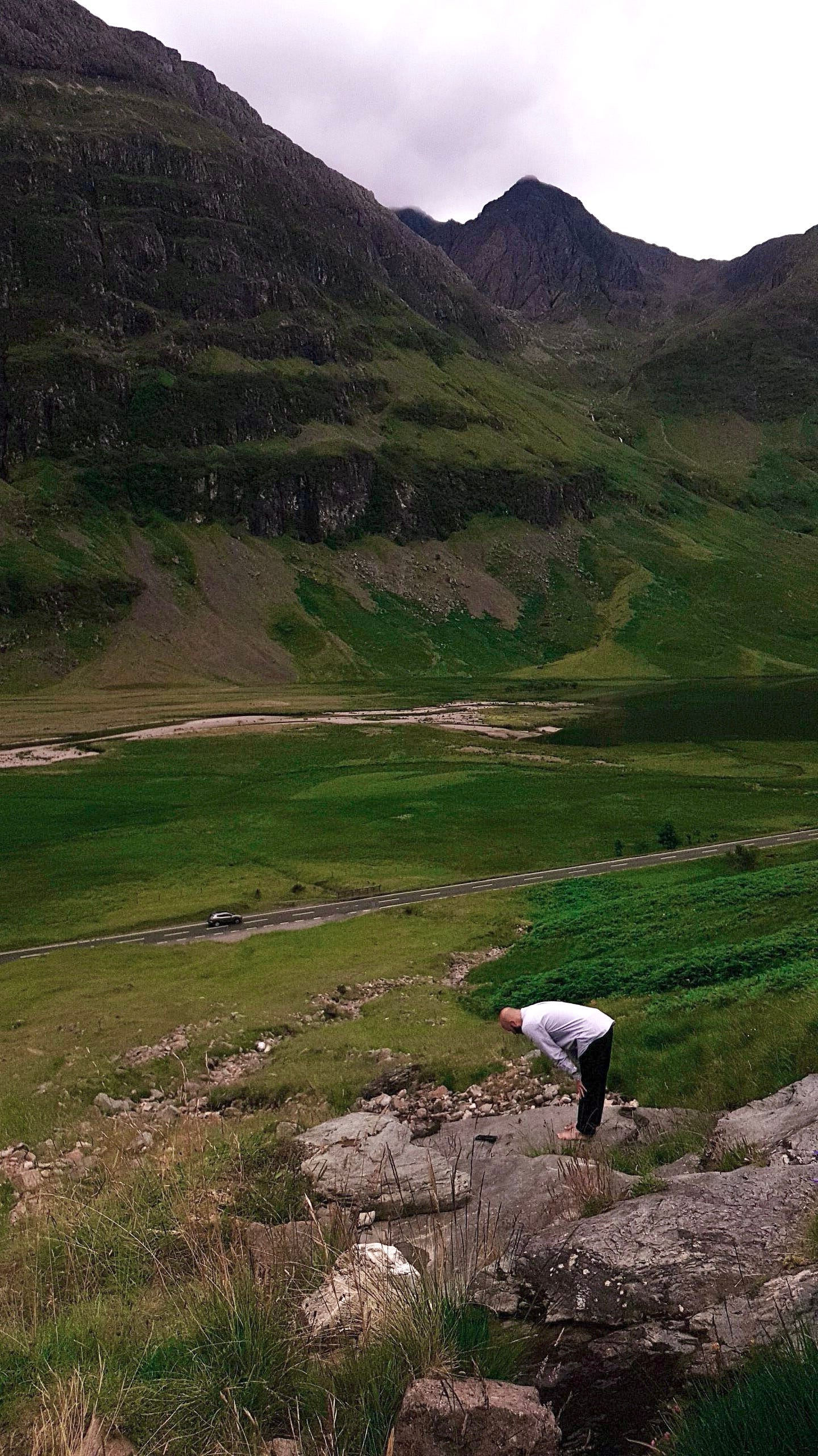
There is something sort of initiatory about the sublime in this reading. It is generative. It doesn’t confirm the ego as beauty does, but it does empty the ego, reveals its contingency, its constructed quality, and in doing so, paradoxically empowers the subject by showing it the difference between itself and its constructions. There is another moment at the Rest and Be Thankful that is etched into my memory. My father had pulled the car over, and I could see in his eyes the same wonderful, terrible awe I felt in that moment. But my dad, God bless him, ran his eyes over the stone monstrosity we had just parked beside for no longer than 30 seconds before he told me he needed to pray. There and then. On the mountain edge. Almost as if to cope. And as he bowed and prostrated, on the cliff edge halfway up a mountain, this incredible scene emerged, and I captured it below. The sublime had confronted my father with his smallness, with his insignificance, and his cope, his comfort, was to reconnect with the source of sublimity itself.
The Islamic Synthesis
Islamic theology, particularly in its mystical elaborations, holds both Jamaal and Jalaal as equally necessary faces of the divine. God is not only mercy; God is also majesty. God is not only intimacy; God is also otherness.
The spiritual state that Jalaal produces is often called hayba (هيبة), meaning awe, reverential fear, the sense of being in the presence of something that utterly surpasses you. And crucially, hayba is not a negative state. It is actually a gift. It is what happens when the ego’s pretensions are burned away, when the part of you that walks around imagining itself to be the centre of things suddenly encounters something that makes that pretension absurd. And in that moment of exposure, something in you opens.
The gnostics were very careful about this. Hayba without uns, awe without intimacy, can be annihilating. It produces paralysis, dread, a kind of spiritual terror that has nowhere to go. But hayba held within a relationship, within a context of trust, of love, of knowing that the overwhelming power is also Al-Rahman, the Compassionate, allows the hayba to transform into wajd, ecstasy, the joy that comes from having been emptied and found still standing.
This is the Islamic parallel to Kant’s discovery: you feel your absolute smallness, and in feeling it, you discover something in you that cannot be entirely small. The spark that can receive the divine, the innermost point of the human being that is capable of touching, however obliquely, the infinite.
The Safe Distance
There is one more thing that needs to be said, and it is perhaps the most psychologically interesting of all.
Both traditions, Islamic and psychoanalytic, implicitly understand that the sublime, the Jalaalic, the encounter with the overwhelming must be mediated. Burke said it: you need the safe distance. Kant said it: you need the frame of reason. Lacan said it: you need the symbolic, the linguistic container that lets you approach the Real without dissolving into it.
What is it that provides that distance? Several things it turns out. Ritual is one. The Islamic prayer, for example, places the worshipper before the divine, but within a highly structured form. The words are fixed. The postures are prescribed. The direction is given. All of this structure is not a limitation on the encounter with the divine it is actually the very frame that makes the encounter survivable. Without the structure, the approach to Jalaal would be annihilating. With it, the worshipper can stand before something infinitely beyond them and return transformed rather than destroyed.
Art is another. This is why poetry, music, and the visual arts have always been the human species’ primary tools for processing the sublime. The poem about infinity is not infinity. The painting of the storm is not the storm. They take you close enough to feel the edge, while the frame of the artwork itself holds you safe. This is why tragedy, which is always about encountering limit, mortality, the Real, has been understood since Aristotle as cathartic. You weep at the theatre and then you emerge, not utterly crushed, but sort of clarified.
And language itself. Lacan’s great insight was that the symbolic order, the world of language, representation, and culture, is precisely what separates the human subject from the devastating directness of the Real. We never encounter things as they are we encounter them as mediated by meaning.
I’m sure there are many larger, taller, more terrifying mountain range landscapes out there that I am yet to feel the wrath of. However, if you are ever in my part of the world, do yourself a favour and make your way through the Rest and Be Thankful. I have seen the fingerprints of God there.
Answer to Something Bigger Than Yourself

It is an irony of our age that, even as the self has been enthroned, the self has also become unbearable. We are told to “find ourselves,” “express ourselves,” “be true to ourselves”, as though the self were a small god to be worshipped and served. Yet the more attention we lavish on this internal idol, the more brittle and joyless we become. The great …
Ibn ʿArabi (1980) The Bezels of Wisdom (Fuṣūṣ al-Ḥikam). Translated by R.W.J. Austin. New York: Paulist Press.
Ibn ʿArabi (1989) The Sufi Path of Knowledge: Ibn al-ʿArabī's Metaphysics of Imagination. Translated and explained by W.C. Chittick. Albany, NY: State University of New York Press.
Lacan, J. (1977) ‘The mirror stage as formative of the function of the I as revealed in psychoanalytic experience’, in Écrits: A Selection. Translated by A. Sheridan. London: Tavistock, pp. 1–7.
Burke, E. (1990) A Philosophical Enquiry into the Origin of Our Ideas of the Sublime and Beautiful. Edited by A. Phillips. Oxford: Oxford University Press. (Original work published 1757; revised edition 1759).
Kant, I. (2000) Critique of the Power of Judgment. Translated by P. Guyer and E. Matthews. Cambridge: Cambridge University Press. (Original work published 1790).
Masha Allah! As a keen hiker who has struggled to internalise adequately the beauty and awe the mountains inspire, and having recently witnessed a volcanic eruption close up, your separating the Jamalic and Jalalic names makes so much sense to my own experience, and the same mountain can offer both perspectives in abundance. Also your ability to weave western thought into classical muslim discourse is so refreshing. You have an invaluable gift. I pray the Almightly guides you to do great things with your talent and keeps you sincere.