

Answer to Something Bigger Than Yourself
On the Pathology of Internal Idols and Transcending them

It is an irony of our age that, even as the self has been enthroned, the self has also become unbearable. We are told to “find ourselves,” “express ourselves,” “be true to ourselves”, as though the self were a small god to be worshipped and served. Yet the more attention we lavish on this internal idol, the more brittle and joyless we become. The great modern epidemics: depression, anxiety, narcissism, and addiction, are not diseases of material deprivation but of self-fixation. The mind turns inward like a snake consuming its own tail, and then wonders why it starves.
Belief in God, by contrast, begins with an act of rebellion against this tyranny of the self. It is the humbling, liberating, and psychologically decisive admission that there exists something beyond me. Greater than me. Whatever else one may say about religion or faith, this simple shift of perspective carries immense therapeutic power. It rescues the mind from the exhausting project of self-worship and returns it to the wider stage of reality.
Depression Speaks in the First Person
Most forms of mental suffering speak in the first person. Depression establishes itself with a self-obsessive rumination and murmurs, I am hopeless, I am nothing, I am worthless. Anxiety frets, What will happen to me? What if? Even grief, perhaps our most noble sorrow, is not exempt. When we grieve the dead, we claim to mourn their loss, but I have come to realise what we often mourn is our own. We do not weep for their losses we weep for our own. Our loss of their presence, their care, their contribution to our story. It is our pain we hold a vigil for, not theirs.
This is not a moral judgment by the way, merely an observation. The self is the lens through which we experience everything, but when the lens becomes the subject, reality collapses into distortion. The self, obsessively observed, becomes pathological. And yet, modern life encourages precisely this. It tells us to look inward for truth, for peace, for meaning, never noticing that the more one stares at oneself, the less one seems to see.
Transcendence as the Antidote
To believe in God is to look outward and upward. Not necessarily to a Judeo-Christian bearded patriarch in the clouds, but to the ancient and indispensable idea that there is a reality larger and higher than any individual consciousness. “God” is a short word for the long standing intuition of humankind that life is not confined to our private psychology. It names the transcendent, the numinous, the principle of order and significance that renders our personal tragedies both bearable and, occasionally, beautiful.
The believer, in orienting toward a greater, transcendent reality, performs a profound psychological manoeuvre: he dethrones the self. Now, this dethronement is not a humiliation the way yielding to a tyrant is, but it is the first breath of freedom after one. It breaks the, frankly, claustrophobic loop of self-reference and restores proportion to existence. To believe in God is to step back from the mirror and see that one is not the main character of the cosmos, and that this is good news.
Carl Jung posited that the human psyche is inherently religious. Our consciousness and unconsciousness are imbued with the quest for meaning beyond the material world and beyond ourselves. Although Jung did not advocate for any specific religion or dogma, he believed that no man or woman can lead a truly adequate life relating only to the material world. We need to be in contact with a divine reality that is superior to us. He even wrote that one becomes neurotic if not in touch with that reality.
Relief From ‘I’
The atheist may object that one does not need God to feel awe or humility, and this is perfectly true. But belief gives that humility a language and a structure, a discipline, rather than a passing mood. It trains the mind to acknowledge its limits and to act as though meaning resides not solely in its own appetites. This is why belief, even stripped of superstition and dogma, remains psychologically valuable.
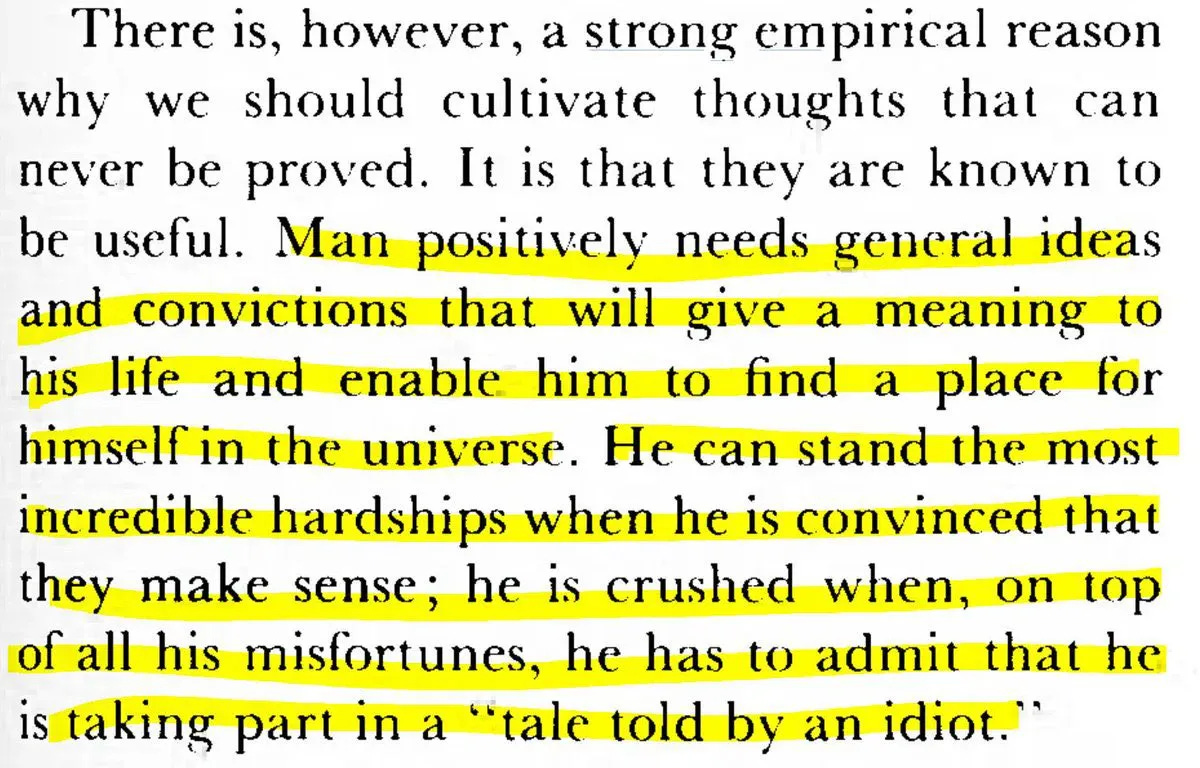
Viktor Frankl, who seemed to see the inside of humanity’s darkest chambers, argued that man’s chief need is not happiness but meaning and that meaning is not generated by introspection; it arrives when we locate ourselves in a story greater than our own. Belief in God, however one conceives Him, Her, or It, provides precisely that context. It says: You are not the measure of all things. You are part of something larger.
And what a relief that is.
The believer’s peace is not that everything makes sense, but that it doesn’t always have to to me. There is a higher intelligence, a greater coherence, a mystery that renders one’s personal failures less final.
Worship, in this sense, is an exercise in proportion. It is the mind reminding itself that it is not itself the summit of being. I personally find that when I pray to God; the bowing, prostrating, supplicating, silently wondering, the iron grip of my ego loosens and a window onto a vastness outside is opened. Therefore, to do this at five incremental times every single day, as the Islamic God prescribes, is a regular inescapable rehearsal of perspective. A daily correction of scale.
Without something greater than the self to serve, the self seems to swell to fill the void, and the results are everywhere: the brittle politics of identity, the performative despair, the disintegration of objective morality, the hunger for validation that networth, number of followers or degress can satisfy.
Nietzsche’s haunting declaration, “God is dead, and we have killed him”, was not a celebration of liberation, as it is so often misread, but an obituary laced with dread. He understood that in killing God, modern humanity had also dismantled the moral and psychological scaffolding that once held the self in proportion to something greater. Nietzsche did not believe in God and yet he knew the value of it. Without a vertical axis of transcendence, the self has nowhere to look but sideways and inward, where it becomes trapped in sterile self-reference. In the void left by the divine, we inflated the ego to divine proportions and called it freedom. But the death of God did not make us gods; it made us orphans; restless, self-fixated, and spiritually malnourished.
Even if one were to regard God as a noble fiction, the fiction is an indispensable one. Even as invention, God performs the essential task of keeping the self from collapsing under the weight of its own reflection. Otherwise we are condemned to orbit endlessly within our own miserable skulls. Wouldn’t you rather, for example, be governed by a person who believes that they answer to something greater than themselves, than by a person who recognises no judgement but their own, even if you’re certain the former’s God is imaginary?
Food for thought.
“I cannot prove to you that God exists, but my work has proved empirically that the pattern of God exists in every man and that this pattern in the individual has at its disposal the greatest transforming energies of which life is capable. Find this pattern in your own individual self, and life is transformed.” — C.G Jung, in a Letter to Laurens van der Post.
References
Beck, A.T. (1976) Cognitive Therapy and the Emotional Disorders. New York: International Universities Press.
Buddha (2007) The Dhammapada. Translated by E. Easwaran. Tomales, CA: Nilgiri Press.
Dostoevsky, F. (2004) The Brothers Karamazov. Translated by R. Pevear and L. Volokhonsky. London: Vintage.
Frankl, V.E. (1959) Man’s Search for Meaning. Boston, MA: Beacon Press.
Hume, D. (1993) Dialogues Concerning Natural Religion. Indianapolis, IN: Hackett Publishing.
Jung, C.G. (1964) Man and His Symbols. London: Aldus Books.
Jung, C.G. (1973) Letters, Vol. 2: 1951–1961. Edited by G. Adler. Princeton, NJ: Princeton University Press.
Kierkegaard, S. (1989) The Sickness Unto Death. Translated by A. Hannay. London: Penguin Classics.
Nietzsche, F. (1974) The Gay Science. Translated by W. Kaufmann. New York: Vintage.
Nolen-Hoeksema, S. (2000) ‘The role of rumination in depressive disorders and mixed anxiety/depressive symptoms’, Journal of Abnormal Psychology, 109(3), pp. 504–511.
Rowe, D. (1983) Depression: The Way Out of Your Prison. London: Routledge.
Seligman, M.E.P. (1991) Learned Optimism. New York: Knopf.
Solzhenitsyn, A. (1972) Nobel Lecture in Literature. Stockholm: The Nobel Foundation.
Tillich, P. (1957) Dynamics of Faith. New York: Harper & Row.


This was profound and well-written, kudos Zahra! I always appreciate your use of Carl Jung's work, and found especially poignant the excerpt from "Man and His Symbols". I agree, having a belief in something greater than oneself is a strong counterbalance to the potentially corrosive influence of the constant emphasis on oneself and one's ephemeral, mercurial moods and emotions.
I think now, more than ever, to have this belief and knowledge of a divine power to whom we supplicate and ask for assistance, provides a strong foundation that anchors one against the constantly shifting tides of the seeming lack of morality/greater meaning in the modern, hyper-materialistically driven world. To constantly introspect but place oneself and one's status as the focus of our lives is to deny ourselves the bulwark of understanding that arises from belief in a higher power. Not to mention, having a sense of purpose and certainty, which you mention in your example of the 5x daily Islamic prayer, can give one clarity and resilience, even as the mundanities of life and being constantly told to focus on what they want weighs them down.
Oh, wonderful words of wisdom. After my beloved husband died, I had the urge to hike. I climbed every mountain I could, and then I drove north and climbed some more. I remember thinking that I needed to situate my life on a larger landscape. I needed to be small. It was a comfort, but more, it was redemptive because - as you say - it delivered me from the “I.” It is this dethroning that opens the heart to others.