

Siblinghood
How Sibling Relationships Shape Us, Tangle Us, and Tie Us to Ourselves

Siblings are, statistically, the longest-lasting relationships in a person’s life. At least by way of longevity, the sibling relationship outlasts parents, friendships, business partners, spouses; nearly everyone. You’d think that kind of permanence, proximity, and shared origin would make it one of the most influential bonds in a person’s life. And yet, much of developmental theory tends to overlook it.
Unlike friends or romantic partners, we do not choose our siblings. They are assigned to us by fate, biology, or circumstance and yet their impact can be just as defining, if not more so. Whether they preceded us or arrived after us, whether we adore them or ache because of them, siblings often become the most enduring relationships in our lives. They play a peculiar and multifaceted role in shaping our inner worlds and social development. They are both the mirrors and makers of our identity and I believe that, if circumstances and relational dynamics allow it, sibling bonds mature into uniquely gratifying friendships of unparalleled depth. It’s one of life’s rare gifts and I’ve personally had the privilege of living it.
Parallel Foundations
More than just cohabitants of childhood, in developmental psychology siblings are seen as key agents in shaping an individual’s cognitive, emotional, intellectual, and social abilities. Much of this is a result of the unique relational structure that siblings operate within. Unlike the vertical hierarchy of parent-child relationships, sibling relationships are more horizontal. This facilitates a psychologically favourable environment for practising negotiation, competition, empathy, rivalry, and collaboration.
As children, our siblings are the first ‘others’ we bump into repeatedly, sometimes literally. Unlike our parents, who hover above us with authority and structure, siblings occupy a parallel emotional space: equal footing, equal vulnerability, equal competition for the last piece of cake and the first glance of approval. It is with, or in the company of, siblings that we first learn emotional regulation and social role-playing. Through conflict and connection, we learn how to manage frustration, how to share attention, how to joke, how to praise, how to sting, how to apologise (or not). Older siblings may serve as caregivers or mentors, while younger siblings challenge norms and claim attention. These interactions can reinforce or undermine a child's developing self-evaluation. Sibling feedback, whether affirming or critical, often has more lasting emotional resonance than that of peers or sometimes even parents, given the emotional intensity and permanence of the relationship. When my sister told me I was good at something I was more inclined to believe her than anyone else.
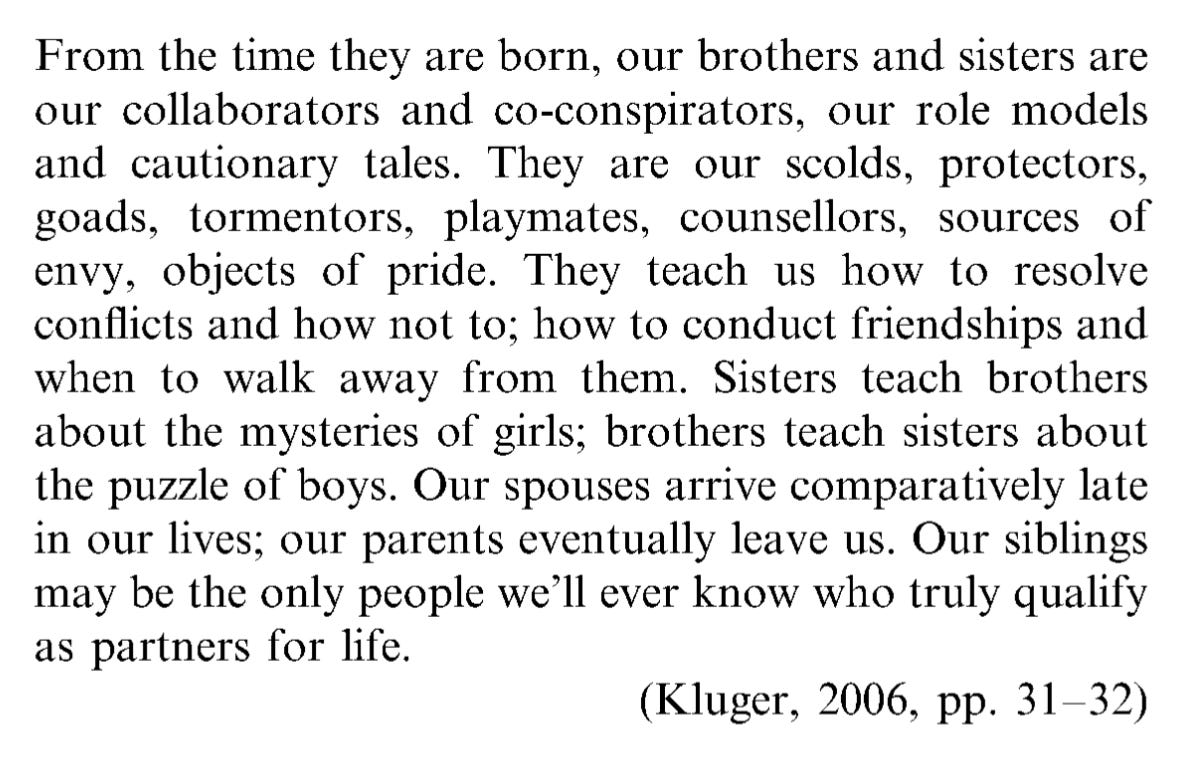
It’s impossible to ignore the power of social comparison in this early mix of personality. We naturally begin to measure ourselves in relation to them: who is smarter, funnier, clumsier, more reliable etc. Sometimes these identities get codified early (the "responsible one," the "wild one," the "peacemaker") and they follow us into adulthood, eventually shaping not just how we see ourselves, but how we expect the world to see us too.
Rivals & Mirrors
From a psychoanalytical standpoint, especially within Freudian and post-Freudian traditions, sibling relationships are rich with unconscious conflict and desire. While Freud obsessed in many ways about the Oedipal triangle (child, mother, and father) his later work, which was later refined, acknowledged the ‘sibling complex’ as a formative source of rivalry, jealousy, and identity conflict.
Siblings compete not only for parental love but also for existential recognition. The arrival of a younger sibling, for example, can be experienced as a deep narcissistic injury; displacing the older child from the exclusive maternal gaze and igniting deep feelings of rejection, betrayal or abandonment. Such emotional injuries can often then become buried in the unconscious and resurface in adult relationships, especially in dynamics of envy or chronic competitiveness.
Melanie Klein, building on Freud, viewed siblings as ‘objects’ in the infant’s internal world: figures that become split into ‘good’ and ‘bad’ depending on how they satisfy or frustrate desires. These internalised sibling figures may later influence how we respond to friends, colleagues, and romantic partners, often repeating unresolved sibling dynamics in adult life.
Psychoanalysis also suggests that siblings can serve as ‘mirrored doubles’: external reflections of our own self-image, aspirations, and flaws. This duality of love and rivalry, intimacy and alienation, makes the sibling bond uniquely psychologically loaded. It is a site where narcissism meets recognition, and where identity is forged not in isolation, but in relation.
Psychosocial Anchors
I truly believe that even though sibling relationships are not chosen or come from organic relational interest, they can paradoxically provide the deepest foundation for authentic friendship. They withstand decades of change, family ruptures, geographic separation, diverging life paths, and thus carry a depth of shared history that no later relationship can possibly replicate. Psychosocially, this shared history functions as a narrative anchor, an implicit reminder for each person of where they came from, who they once were, and how far they have come.
As adults, siblings often re-encounter each other anew; outside of the family hierarchy. If early traumas have been processed, or rivalries outgrown, the bond can transform into a friendship of truly profound intimacy. Unlike friends made in adulthood, siblings have watched each other grow through every awkward, painful, or triumphant phase of development. This kind of witnessing cultivates, in my personal opinion, an emotional safety like no other and a sort of unspoken non-verbal understanding that is rare. Where many adult friendships are built on compatibility, sibling friendships are built on the deepest kind of familiarity.
Even when relationships are strained or distant, the phantom presence of a sibling lingers in the background of the psyche. For example, one may still feel the need to outperform, appease, or differentiate from them. Conversely, when relationships are close and mutually supportive, siblings can provide a source of enduring support, a reminder that we are known and accepted across time, mistakes, and reinventions.
To speak of siblings is to speak of time, memory, identity, and longing. They are witnesses to our formation, rivals for our belonging, and potential best friends in our maturity. Psychologically, they shape our ability to love and to be loved. Psychoanalytically, they haunt and hold unconscious dramas. Psychosocially, they are the original co-constructors of our roles, values, and relational patterns.
When we are lucky, the sibling bond becomes a lifelong sanctuary for the self.
See also:


References:
Erikson, E.H., 1950. Childhood and society. New York: W. W. Norton & Company.
Erikson, E.H., 1968. Identity: Youth and crisis. New York: W. W. Norton & Company.
Festinger, L., 1954. A theory of social comparison processes. Human Relations, 7(2), pp.117–140.
Freud, S., 1923. The ego and the id. Translated from German by J. Strachey, 1961. New York: W. W. Norton & Company.
Freud, S., 1914. On narcissism: An introduction. In: J. Strachey, ed. 1957. The Standard Edition of the Complete Psychological Works of Sigmund Freud, Volume XIV. London: Hogarth Press, pp.67–102.
Klein, M., 1952. Some theoretical conclusions regarding the emotional life of the infant. Envy and Gratitude and Other Works 1946–1963, 1975. London: Hogarth Press, pp.198–236.
Klein, M., 1946. Notes on some schizoid mechanisms. International Journal of Psycho-Analysis, 27, pp.99–110.
Toman, W., 1961. Family constellation: Its effects on personality and social behavior. New York: Springer.
Dunn, J., 1983. Sibling relationships in early childhood. Child Development, 54(4), pp.787–811.
Dunn, J., 2002. Sibling relationships. In: P.K. Smith and C.H. Hart, eds. Blackwell handbook of childhood social development. Oxford: Blackwell, pp.223–237.
Buhrmester, D. and Furman, W., 1990. Perceptions of sibling relationships during middle childhood and adolescence. Child Development, 61(5), pp.1387–1398.
Subhan’Allah, I’ve always valued the relationship my brother and I have, but lately I’ve realised how rare it actually is. Our dynamic is solid, quiet and built on mutual respect. "This kind of witnessing cultivates, in my personal opinion, an emotional safety like no other and a sort of unspoken non-verbal understanding," spoke volume because he’s never crossed a line, which I can’t say for many others in my life. I’m grateful, and I hope everyone gets to experience a bond that grounding. Thank you for sharing such a well written piece.
siblings actually shape our genes. they are the most important force shaping our characters, personality. an older sister make the young brother more feminine, less aggressive (for better or worse). Frank Sulloway's 'Birth order, family dynamics, and creative lives' (1996) inspired me to psychoanalyze my own situation, #5 of 7. very helpful.