


If psychotherapy, as it was conceived, could observe a session of psychotherapy as it is practised today, it would not recognise itself.
Before I describe what true psychotherapy is, I think it would be wise to describe what psychotherapy is not. Psychotherapy is not advice-giving, it is not emotion-validating, it is not gender-affirming, it is not decision-making. In this cultural climate where individual experience is paramount and individual pursuits of happiness are the goal, therapy has been defaced and disfigured into a tool for the self-indulgent. Unfortunately, much of modern ‘psychotherapy’ amounts to reassuring the client of the righteousness of their (usually problematic) behaviour. The principal goal seems to be to make the client feel better ("It's not you, it's them") about themselves and to learn to accept all aspects of themselves (adaptive or maladaptive) for what they are. Any semblance of guilt or shame is quickly banished from the room as if they are offensive and unnatural. Self-reproach in any form is not tolerated. Therapists will often try to repair self-devaluation attempts from the client or compensatory self-inflation attempts by commenting to clients on their ‘good’ qualities or giving the equivalent of pep talks. None of this is psychotherapy.
The word psychotherapy is derived from the Ancient Greek words: ψυχή - ‘psyche’ (meaning soul; spirit; breath), and θεραπεία - ‘therapeia’ (meaning care; healing; treatment). Thus, psychotherapy in its original form and conception refers to ‘the care of the soul’. So what does the ‘care of the soul’ entail? First and foremost psychotherapy is fundamentally a relationship. The driving force for growth and the actual agent of change in therapy is the relationship formed between the therapist and client. This is crucial because meaningful psychological growth can only occur in the context of relationships. This fact is why the self-care and self-love movement for mental health is a monumental failure. We do not even develop our sense of ‘self’ and a self-concept in isolation.
Our self-image and all the assumptions we hold about who we are, are first established in the context of our earliest relationships. How lovable I am, how interesting I am, how funny I am, how useful I am, how reliable I am - those are things I learn about myself based on the observable reactions of my parents, siblings, and peers to my behaviour in real time. If we were asked about our day at school and then not given a chance to answer we may learn we’re not interesting, if we’re not asked about our day at all we may learn we’re not important, if our tantrums are met with silence we may learn we are not worthy of love, if our tantrums are met with anger and frustration we may learn that we are fundamentally bad. What was learned in a relational context can only be modified in a relational context. Thus, what genuine psychotherapy provides initially is a contained and secure relational context where you can: 1) understand your current self-composition and 2) endeavour to modify the elements of it that are wreaking havoc in your life.
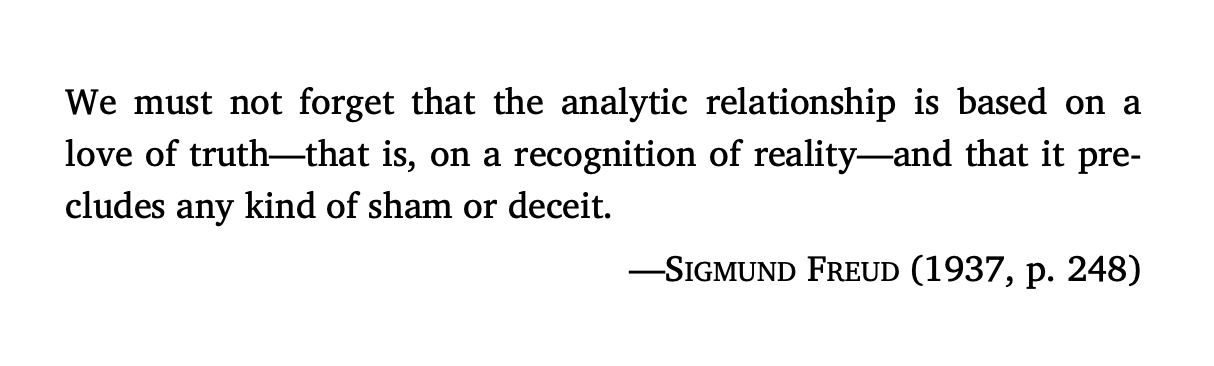
The methodology by which this process takes place in the therapy room is extraordinary and yet so intuitive. There are a number of diverse therapeutic approaches that can inform psychotherapy as it occurs in the room, however, any approach implemented effectively by the therapist will share the principal aim of cultivating an increased capacity to acknowledge what is not conscious in the client - that is, to acknowledge and admit what is difficult or painful to see in ourselves. The overarching goal is truth. After all, it is the lies we’re told & internalise or the lies we tell ourselves that form the obstacles that prevent our growth. The psychotherapist Carl Rogers firmly held the core belief that every human being has deeply embedded within the depths of their psyche a self-actualising force that compels them towards goodness and self-development. This is a view on human nature I share. I believe we all have an innate desire to perfect ourselves (detailed in: Religion’s Only Aim is to Perfect Personality). Therefore, it is not my job as a psychotherapist to inspirit the client with the ingredients for change (with gratitude, or compassion, or curiosity, or any of the myriad of characteristics that initiate growth). The ingredients are already there. The job of a therapist is to simply to identify and remove the obstacles in the client’s way and the rest will follow automatically. Psychotherapy is fundamentally a pursuit of truth.
It is a privilege to practice psychotherapy because of that. I often explain good psychotherapy as ‘self-reflection with help’. In both the East and West, the practice of self-reflection is a pillar of faith and a form of worship for many. Self-reflection is ultimately an antidote to delusion. Our delusions are what hold us hostage to our misery; the delusion that I must please everyone around me or I am of no value, the delusion that every conflict holds with it the threat of separation and isolation, the delusion that ‘they’ are the problem and that I am the victim, the delusion that relying on and needing others is a weakness. I often hear people describe how their experiences ‘changed them’ but that is not an accurate statement. It is not our experiences themselves, but our reflection on those experiences, that change us. Without reflection you simply wander and pass through those experiences learning nothing, changing nothing, understanding nothing.
However, it is not easy to peer into oneself alone. It is even harder to face what you find with honest clarity. In some sense our judgements and assessments are a product of the contents of our psyche. Thus, it is incredibly difficult to accurately evaluate your own thoughts, feelings, behaviour, and temperament without bias. As Joseph Luft and Harrington Ingham clarified in their formulation of the Johari Window model, there are three main levels to self-knowledge: 1) the things we know, 2) the things we know that we don’t know, and 3) the things we don’t know that we don’t know (blind spots) [1]. The third category cannot be accessed through self-reflection in isolation, it is exclusive to the relational domain. A good therapist will guide you through the process of uncovering your blind spots and confronting them rationally. It is utterly fascinating to witness a person’s understanding of themselves broaden and deepen simultaneously. We all have a much greater capacity to bear painful truths about ourselves than we realise.
Every client is completely unique in their experiences, belief system, narrative style, trust in others, and general approach to the relationship. Every therapeutic dynamic is, therefore, distinct from others and those individual differences are what makes psychotherapy complex, dynamic and incompatible with typical standardised medical technique. In other words, a new and unique therapeutic approach must be formulated with every single client. I could elaborate on the therapeutic process and all of its intricacies for pages and pages drawing from many wonderfully transformative examples. However, I feel compelled to highlight what is, from my experience, the primary healing component of every therapeutic relationship. 90% of good therapy is listening. It’s a particular kind of listening that friends, family, and colleagues rarely, if ever, offer to us. It involves all the senses. I listen not only to what is said, but also what is not said, what is inferred, what is hidden, how it is hidden, and what it is hiding under. I listen to the storyline and for themes. As the client speaks and unravels I develop a sense of the associative networks behind the client’s interpretations of their experiences. Being on the receiving end this kind of listening is truly one of the most cathartic experiences possible.
So many people go their entire lives without ever experiencing what is like to tell someone their thoughts, feelings, opinions, and have that person truly listen. It is a tragedy. There is unbelievable value in attempting to formulate a thought into words, hear yourself say it, and then hear it repeated back to you. Clients relay to me thoughts that have occupied the corners of their minds for years without surfacing. I listen, without judgement of my own, and open up the space for those thoughts to be expanded, explored, and challenged. I see the level of solace from simply being listened to in their faces. It is a beautiful process. This is another failure of modern therapy. Modern therapists, often overly concerned with maintaining a superficial positivity in the room, do not truly listen to what is said and so they miss what isn’t or perhaps what cannot be said.
I acknowledge that the claim in the title of this piece is bold. However, if you are religious and have decided to embark on The Journey to Perfection, I believe three characteristics of psychotherapy qualify it as act of worship: 1) you are engaging in a pursuit of truth, 2) you are in a state of self-reflection with the goal of self-development, and 3) these things are happening in the context of a relationship with another soul in God’s kingdom.


Absolutely love this. Thank you so much for this important piece. 🤲🏼❤️
To bear witness and just listen for what’s not being said, to listen without judgement— truly a gift that few people possess!! Mashallah Zahra. 💕💕💕