


There are very few topics more disputatious than religion, and yet, there is nothing I think about more. It pervades my every thought, and it is what inspires so much of my writing. There is so much beauty in religious belief and, in this essay, I hope to impart a fundamental feature of its beauty that I find remarkable. All religious thinking is really an attempt at formulating the ideal personality structure. Every faith system, whether ancient or modern, Eastern or Western, seems to represent an effort to outline the highest potential of human character and then provide a practical methodology, through rituals, practices, and disciplines, to actualise that potential.
The Universal Common Denominator
Homosapiens have a seemingly unmovable inherent human inclination toward perfection. This is not an original observation of mine; many of the greatest Western & Eastern minds, including Plato, Aristotle, Confucius, and Ibn Sina, have articulated time and time again an inherent drive for perfection. It is not a difficult thing to observe for yourself. We are all intrinsically attracted to the whole and flawless. We beautify ourselves, we climb cooperate ladders, we look for the perfect partner, we seek bigger houses and better cars. We yearn to self-develop; to become better than we currently are. For centuries, this impulse was conceived in metaphysical terms. Self-development was not a social aspiration; it was an ontological orientation. After the rise of Cartesian materialism and the decline of classical metaphysics in the West, it was recast in a new vocabulary: self-actualisation. Carl Rogers wrote about this drive and posited that every person has an innate self-actualisation force deeply embedded into the depths of their psyche that, without any obstacles in its path, inevitably and necessarily develops each person to become their highest and most complete form. The task is simply to remove the obstacles.
One way in which this inherent drive for perfection manifests most plainly is as human admiration. When I admire a person, it is because there is something about the way they are that inspires respect or awe in me. That awe may be a feeling, but it is not passive; it compels imitation. It produces a desire to become what we admire. In admiring, I encounter a quality or way of being that reveals to me what I could be. Consider a genuine example of my own: I was somebody who struggled to inform restaurant service staff when a mistake was made with an order, and it maddened me. The prospect of correcting them was so mortifying to me that I often resigned myself to eating the meal I didn’t order and didn’t want. That changed more or less instantaneously after watching a colleague do it so masterfully. She raised a hand, smiling to call the staff over and then explained the mix-up with effortless grace. She was clear, kind, and exuding confidence. I was in awe and, naturally, sought to imitate it. I now, almost unconsciously, find myself borrowing her very words in moments like that.
What happened in that small moment is a microcosm of something profoundly human. The same impulse that drives a person to apply for a promotion, to start therapy, to train for a marathon, or to embark on a PhD springs from the same source: the insistent urge to become more than we are. We are in constant admiration of excellence wherever we find it. What moves us in those moments is often awe and sometimes envy, but always a glimpse of our own latent potential made visible in another.
God as The Imagined Totality of All Perfection
This is where faith finds its place. If admiration is the mind’s recognition of a semblance of perfection in another, then what are we truly admiring? Each instance of admiration, whether for eloquence, beauty, courage, wisdom, kindness, or composure, is a momentary encounter with an ideal. When I admire someone’s grace or patience, I am not merely responding to the person themselves, but to the quality they momentarily embody; a fragment of something greater, a glimpse of perfection itself.
This, I’ve found, is one of the most fascinating ways to understand what we call God. The traits we admire in others are reflections of an ultimate standard; mere glimpses of the absolute source of perfection: God. If we were to take every admirable person and extract from them only the essential features of what is ‘admirable’ and worthy, and then gather and unite those fragments into a single being, we would arrive at something resembling the divine. He is the imagined totality of all perfection. Therefore, a functional way to define God is: the complete spirit a person must emulate in order to thrive. A personality framework to implement. What I have just described is the unique Islamic conceptualisation of the monotheistic God (God as الكمال المطلق), which differs in fundamental ways from Christian and Jewish theological accounts.
This totality of perfection is every admirable trait measured to the absolute amount. Therefore, God is not merciful; God is mercy. God is not just; God is justice. God is not benevolent; God is benevolence. God is not wise; God is wisdom. God is not generous; God is generosity. When we, as human beings, imitate and acquire those ethically admirable traits, whether observed in nature or in others, we imitate God and implement the ideal personality framework. We become merciful, just, wise, and generous, and it is that very imitation of His perfection that is considered worship.
In the Islamic tradition, the purpose of life is to ‘meet God.’ Heaven is only the reward for doing so; the real aspiration lies in the encounter itself, in ‘reaching’ God. As a child, I would hear those words in Saturday school and at home, mysterious and cryptic. My curiosity was shared even by the adults who so often spoke of it. It is a concept scattered throughout Islamic literature and so often repeated with reverence, even when its meaning is unclear. It is through the conception of God outlined above that the meaning of those words has begun to unfold for me. If God is the totality of perfection, what does it mean to reach Him? To move towards Him?
What becomes clear is that this movement towards God is not in distance, but in character. To perfect our character, to trim the edges of our pride and greed, to imitate his justice and kindness, to emulate his essence is to move towards Him. If we are to reach God, we must become like him. What happens to be even more beautiful than this conception of gaining proximity to God, is what the Islamic tradition describes as happening when you get there. The more we imitate and exhibit the traits that are essential to God and thus become a microcosm of his essence, the more we gain an understanding of him. This understanding is not scholastic or literal; it is experiential. How magnificent is that? To imitate him is to move towards him, and to move towards him is to know him, and to know him is, of course, to love him.
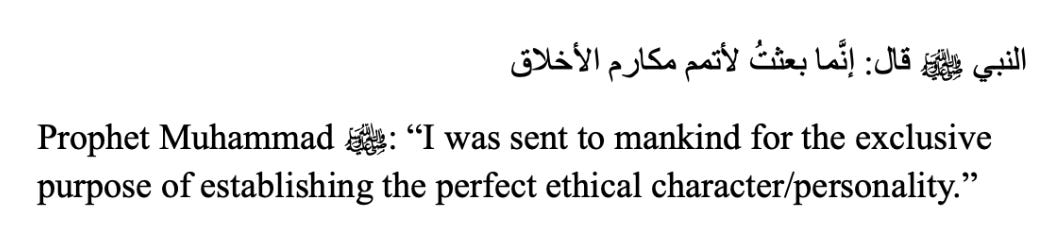
Every Islamic practice (Sunnah) taught and implemented by the Prophet was done with the intention of formulating the ideal character and personality structure for humanity to imitate. Prayer done meticulously five times a day at precise and inflexible times is a clear exercise in developing an individual’s discipline & focus. An annual fast of 30 days is a clear exercise in developing an individual’s patience & empathy. A compulsory charity tax on any disposable income made is a clear exercise in developing an individual’s generosity & humility. Rituals and practices serve the sole purpose of elevating a person’s character in the direction of the divine. Each act of worship is not merely a ritual but a transformative tool designed to refine the soul and align human nature with higher virtues.
However, this attempt to formulate an exemplary personality through religious constructs is not unique to monotheistic religions. Ancient archaic belief systems, such as Greek mythology, reveal a similar underlying structure. The pantheon of Greek gods represents various facets of the human personality, each deified and exaggerated to archetypal proportions. In Homer’s Iliad, for example, the gods are magnified as large expressions of human dispositions. Ares, the god of war, is the personification of unrestrained aggression and bloodlust. Homer describes him as the “most hateful to me of all gods who hold Olympus” (Iliad 5.890–897), condemned by Zeus precisely because he embodies violence without measure or reason. By contrast, Athena represents strategic reason harnessed to moral restraint. She is glaukopis (clear-eyed), and intervenes not through brute force but through counsel, foresight, and tactical precision. He depicts the fascinating process of integration that the gods demonstrate. For example, in a glorious dramatisation of the struggle between fury and reason within the human soul, it is Athena who restrains Achilles at the moment his rage threatens to become self-destructive.
Unlike Islam, which anchors ethical life in a unified and absolute source of perfection, Greek religious thought was fundamentally pluralistic. The gods were not worshipped so much as contemplated, admired, and selectively imitated. They were individually flawed. The objective was sōphrosynē: a state of balance and self-mastery achieved by acknowledging the legitimacy of multiple drives (represented by each god) without allowing any single one to tyrannise the whole. It was an early attempt to externalise the structure of human personality, fragmenting it into divine figures so that it could be examined, admired, feared, and ultimately integrated.
Similarly, in polytheistic systems like Hinduism, deities such as Vishnu, Shiva, and Kali represent radically different modes of being: preservation, destruction, ascetic withdrawal, creative chaos, each necessary, yet none exhaustive of the whole. The gods themselves often grapple with their flaws, making them relatable and serving as lessons for mortals. Moral insight arises not from obedience to a single ethical axis, but from discerning when a given quality is appropriate and how it ought to be expressed. In such systems, religious narratives invite the individual into an active role as moral interpreter. By observing the often contradictory actions of the gods, their triumphs as well as their failings, humans are encouraged to decide for themselves which traits to emulate, which to restrain, and which to reject altogether. The ideal self is not handed down fully formed; it is assembled through reflection, comparison, and judgment. Moral authority is therefore less centralised and more dependent on individual interpretation.
Regardless of theological framework, it seems that human beings collectively seek, with a remarkable desperation that transcends time and culture, to self-actualise and religion, at its core, functions as a blueprint and strategy for self-transcendence. Whether through monotheism or mythology, faith offers a vision of what we could be, if only we had the discipline, patience, and humility to pursue it. Perhaps the ultimate purpose of religion is not merely to worship for the sake of worship, but to worship to travel closer to what it is we worship; to strive, to evolve, and to reflect, in our own limited way, the perfection we so instinctively seek.


I have to correct myself. The saying, “If it is written” or “If God wills it” Inch’allah is beautiful to me. Less a predestination mode than a surrender to God’s love and the straight path. That’s how it seems to me.
Zahra, thank you for this. I've been trying to formulate my own thoughts on this from a Christian perspective for some time and you have expressed so eloquently and succinctly what's been quite nebulous for me. Gratefully to have received these words today.