

In(ter)dependence
On Human Chemistry and the Myth of Self-Sufficiency

Some interpersonal encounters mimic chemistry. Two people meet and very quickly find themselves colliding like reactants in solution. If the conditions align (temperature, concentration, that ineffable catalytic spark), something irreversible begins. Both emerge changed, transformed, their original structures rearranged at a fundamental level, unable to return to what they were before the encounter. Perhaps you’re recalling one of those moments in your mind right now. We are designed to be altered by one another. And yet, we've been taught to mistrust it, avoid it, even pathologise it.
Modern culture has canonised independence as the ultimate marker of maturity, health, and self-worth. Wellness influencers, therapists on glossy podcasts, and self-help literature insist that ‘happiness must come from within.’ We are told to ‘protect our peace’, to cut off anyone who ‘disturbs’ it, to build a fortress of emotional autonomy where our well-being is untouched by others. Dependency is cast as weakness. To need another is to fail at selfhood. You are assumed deficient in some capacity and must work on yourself to develop a “greater sense of self.” And yet, the cultural outcome has been unprecedented levels of reported loneliness and disconnection. Rates of depression and anxiety surging. We are more isolated than ever and encouraged to see it as a strength.
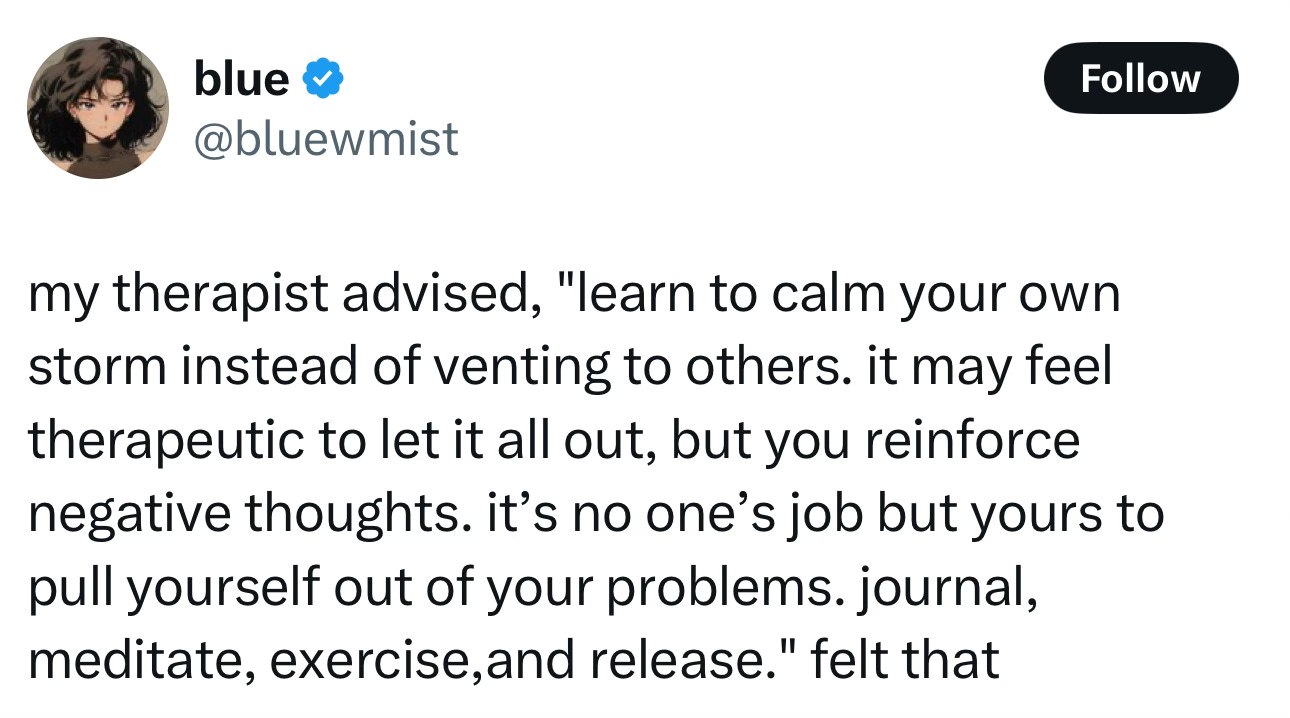
We are to self-soothe, self-care, self-medicate, self-manage, and ‘self-regulate’, as if stability were something one ought to manufacture alone. But regulation, in its most literal sense, implies something external doing the regulating (a regulator), and something being regulated, and then a causal steadying relationship between them. ‘Self-regulation’ is fundamentally oxymoronic: you cannot regulate a system from within the system. Think of a thermostat. The temperature of the room rises or falls, and the thermostat responds by turning the heating off or on, keeping the system within bounds. The room does not regulate itself and the thermostat simply corrects deviations. That is regulation in its most literal form. Much of what gets called ‘self-regulation’ is better understood as the subtle, ongoing co-regulation of life with others, so familiar and so continuous that it disappears from view, leaving us to mistakenly credit an inner mechanism for what is, in fact, a shared human achievement (read My Problem With ‘Self-Regulation’ for more on this).
The reality is that we are dependent beings. We enter our material existence as infants, completely helpless and entirely dependent on our parents. We rely on them for food, water, health maintenance, hygiene maintenance, language development, etc. We then evolve into more competent social beings and develop our own romantic relationships in which we become interdependent. Couples will depend on each other emotionally, financially, logistically, etc. Even in instances where we can end up leaving the nest alone, we are dependent on friendships for companionship and communities for support. Finally, in the last stretches of our material existence on earth, we then often become dependent on our children. A beautiful full circle reality. We enter life dependent on others and conclude life dependent on others and our biology and physiology tell a coherent story.
We are not Solitary Systems
Human beings are not closed circuits of self-sufficient energy. We are open systems, designed from birth to live within webs of physiological and psychological co-regulation. An infant does not merely want their mother; their survival depends on her body. The mother’s heartbeat entrains the infant’s, her voice tones regulate the baby’s stress hormones, and her presence stabilises their tiny, fragile nervous system. This is not poetry but measurable biology.
And here is the crucial point: that interdependence does not vanish in adulthood. Research in psychophysiology shows that romantic partners, over time, become biological extensions of each other. Studies by psychologists such as James Coan, Beate Ditzen, and others have repeatedly shown that couples literally synchronise at the level of the body:
Heart rate & blood pressure: Long-term partners exhibit cardiovascular synchrony. Couples' heart rates synchronise when sitting together, even when they cannot touch; a phenomenon that disappeared when they paired individuals who weren’t romantically involved. When one partner’s heart rate spiked under stress, the other’s mirrored it, even if they were sat silent in the same room. Even thinking about a romantic partner as a source of support lowers blood pressure reactivity to stress just as effectively as having them physically present.
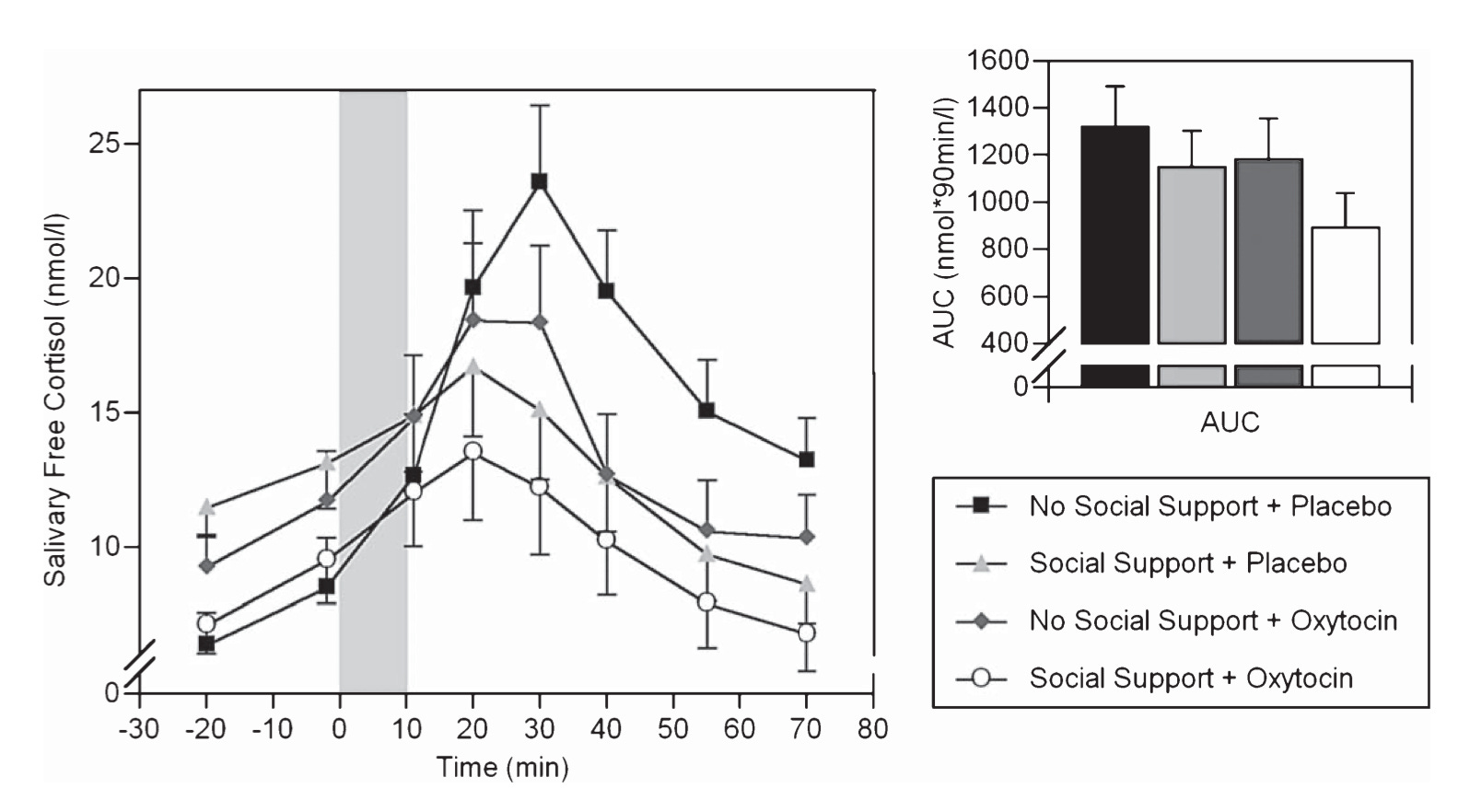
Hormones: Oxytocin levels are significantly higher in new lovers compared to singles, and affectionate touch increases oxytocin while decreasing cortisol driven anxiety and stress. Even viewing images of romantic partners activates dopamine-rich reward regions in the brain, creating cascades of neurochemistry that can stabilise mood and motivate continued bonding.
Breath & brain waves: Using simultaneous brain-to-brain scans of two people, researchers have discovered that romantic partners' neural patterns synchronise during interaction in ways that strangers' do not. EEG studies reveal gamma rhythm synchronisation in temporal-parietal brain regions when two people engage in conversation or shared silence. Similarly, partners' breathing rhythms align when they're within just a few feet of each other, even without physical contact or speech, a phenomenon that intensifies with relationship satisfaction and occurs spontaneously during shared presence.
It borders on the miraculous. Our nervous systems are not independent engines. They are linked circuits, constantly exchanging signals, shaping one another’s health. To be in love, to be in close friendship, to even be in close proximity to another is to enter into a kind of physiological duet.
The Costs of Hyper-Individualism
The wellness narrative, ‘fix yourself alone, from within’, misunderstands suffering as an exclusively private failure of chemistry or willpower. Trauma, inequality, poverty, and isolation are erased. The remedy becomes endless but vapid self-improvement: more mindfulness apps, more supplements, more grit. But this ignores what biologists and psychologists alike have demonstrated: healing requires others.
Touch can down-regulate pain almost as effectively as opioids. Being ‘in-love’ alters not only subjective well-being but also immune functioning. Loneliness, meanwhile, is as physiologically toxic as smoking fifteen cigarettes a day. To deny dependence is not resilience; it is to wage war against human design.
However, co-regulation extends beyond the intimate sphere. Human beings are tribal animals. We entrain not only with lovers but with groups, aligning our identities, our emotions, even our risk-taking behaviours with collective rhythms. Protesters marching shoulder-to-shoulder, sports fans chanting in unison, congregations praying together, each creates neurobiological synchrony. Belonging is not just symbolic; it is embodied (read Ibn Khaldun’s Theory of Crowd Psychology: ‘Asabiyah for more on this). Even destructive tribalism, political polarisation, and violent fandoms reveal the same root: the longing to fuse with others, to dissolve the illusion of separateness. The need is not pathological in itself; it is deeply human. What matters is where we place it.
Perhaps a philosophical step further is to consider that maybe my life is not about me. Maybe the purpose of my life transcends me. Perhaps the potential of what I can achieve is far greater than ‘I’. Altruism has become so distant it’s as if the word itself is not a word in the English language, but part of some other foreign dialect. I would even go so far as to say the concept is treated with social contempt. It is as if it is ridiculous, naïve, and worthy of mocking to put another person’s needs entirely above your own. I can recall multiple instances, for example, of witnessing a person give loose change to homeless individuals and being scoffed at. Why do eyes roll at the unconditional service of others?
Here lies the challenge: in a culture that mocks altruism as naivety and reliance as weakness, how do we reclaim dependence without collapsing into dysfunction? To be entirely dependent, fusing with another so completely that one’s boundaries dissolve (Codependency), is undoubtedly harmful. Yet to deny dependence is equally disfiguring.
Interdependence
Interdependence is a dynamic interpersonal system in which individuals maintain integrity but remain permeable to one another. Interdependence means recognising that my nervous system is not sealed off from yours. That my calm regulates your stress, and your touch stabilises my heart. That my life may not, in fact, be about me, but about the circuits of care I build with others. Those moments you recalled at the beginning, when two people meet and something irreversible begins, are not failures of boundaries. They are proof of our fundamental nature. We were never meant to be noble gases, complete and unreactive. We bond because we must. We alter and are altered because that is what living systems do when they encounter the right conditions, the right catalyst, the right other.
Independence has become the secular gospel of the wellness age. But we are porous beings, built for reciprocity. To thrive is not to be untouched but to be touched well. To regulate others and be regulated in turn. To recognise that autonomy and connection are not opposites but interlocking rhythms.
Perhaps a little less self-help and a little more help-others is due.


Interesting read! I think the push towards hyper independence is a symptom of a problem in society where we constantly swing between extremes when we find problems with one end of a social spectrum - in this case swinging away from the hyper dependence that we saw in more traditional conservative households or collectivist communities.
Growing up in a family from a subcontinent background, I have seen how dependence and using others as emotional support can lead to hurt and pain when implemented without understanding and consent. Adults need to have some level of self emotional regulation to sense their internal “temperature” using your metaphor and determining the right course of action on their own or knowing when to ask for help.
The ability of a human to identify one’s own thoughts, feelings, and emotions and view them rationally and decide on a course of action is an essential form of self regulation in my opinion. Otherwise we end up hurting those around us who may not understand or be able to handle our unregulated thoughts/feelings/emotions.
I think the key here is a tiered approach: 1. Building tools to be able to self manage yourself to function in daily life without completely breaking down (this is where things like meditation, prayer, mindfulness are very useful), 2. Building consent driven relationships with those close to you to share your thoughts/feelings and get their help without overwhelming and harming them, 3. Understanding when normal people can’t help because your feelings are too much and may require professional help.
I do agree though that we’ve moved so far to the extreme of hyper independence that we’ve lost the beauty of what it means to have people close to you you can share your closest, rawest moments with. The power of human connection to help build each other up to better themselves is one I’ve experienced myself and find so powerful. Other people can give us alternate perspectives and give us new ideas for how to improve ourselves we’ve never thought of before.
love this!
i always wonder is it possible to heal while in relationship. but healing requires supportive environments. it is really hard if we’re trying to heal in the place where hurt comes from the closest people.
and the challenge in this modern society, people are reckless and constantly fall into relationships that destroy them.
it may take longer for people who are raised or exposed to abusive relationships to differentiate what’s good and healthy for them, otherwise they would fall into loop and attract same toxic connections. thus, self-help might still good for those who constantly overstimulate themselves from bad connections and hardly reflect on their trauma.
i do hope people meet good connections and co-healing instead of self-healing 🥲