

Ibn Khaldun's Theory of Crowd Psychology: ‘Asabiyah
A Clear Look at How Group Belonging Shapes our Behaviour, Weakens our Individuality, and Influences Societies More Than we Like to Admit

We like to imagine ourselves as autonomous sovereign creatures; self-possessed, self-directed, immune to the gravitational pull of the collective. I certainly do. Yet the moment we enter a crowd, a group, a room, something in us loosens. Boundaries blur. Judgement softens. The individual mind, carefully and sometimes meticulously cultivated in solitude, becomes strangely porous. I find myself altered by my proximity to others.
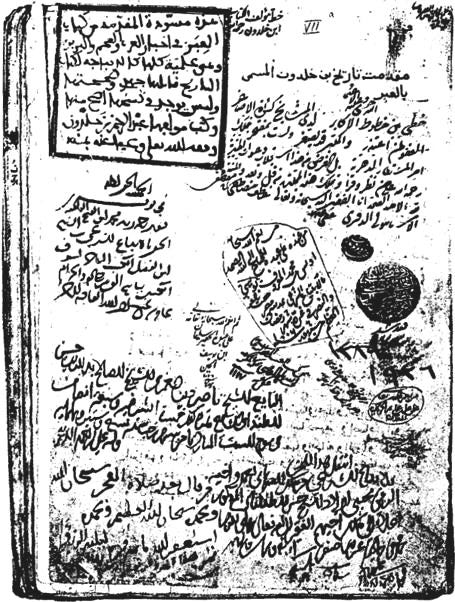
Centuries before modern psychology began to map this phenomenon, the 14th-century Arab scholar Ibn Khaldun identified and articulated this binding force as ‘Asabiyah’ (group feeling/social solidarity) in his seminal work, ‘The Muqaddimah’. The etymology of the word is fascinating. Asabiyah stems from the Arabic root ‘asaba, meaning to bind, to twist, or to wrap around. It implies a sort of tension; the way a turban is wound tight around the head or a ligament holds bone. This same root gives us the Arabic word for ‘nerve’ (‘asab). Khaldun’s concept, therefore, was never only about social agreement; it was about physiological connection. It describes the nervous system of the tribe, a shared circuitry where a signal transmitted by one is received by the whole, bypassing the individual mind entirely.
Moving between the cohesion of the Bedouin tribes and the corruption of royal courts, Ibn Khaldun observed ‘crowd psychology’ centuries before we had the language to map it. He saw that the seduction of belonging is the engine of history: it is, and has been, the force that can bind a people into a weapon capable of building a dynasty, and the loss of which inevitably guarantees its collapse. Asabiyah, to him, was the fundamental glue of human civilisation. The thread that binds individuals into a coherent unit, making them more resilient than the sum of their parts. But I believe it is even more invasive than than. Asabiyah is not only a sociological glue; it is a psychological solvent.
Human beings are profoundly social animals. Our nervous systems are optimised to synchronise: heart rates match, blood pressures regulate each other, emotional states converge, behaviour aligns with the group long before we consciously choose to conform. This has always been the case. What we call a ‘crowd’ is simply a larger, more volatile version of the ordinary social field in which the brain has always existed.
The philosopher Ortega y Gasset once described the ‘mass’ as “the sum of all the solitary zeros.” I suspect he meant it as an insult, but psychologically, he was not far off. In a crowd, the self doesn’t quite disappear; it simply becomes negotiable. The individual ego cedes space to a shared emotional current.
Social Surrender
Crowds have been interesting to philosophers like Ibn Khaldun and modern psychologists alike because of how they undermine the ordinary checks and balances of the brain. Under conditions of collective arousal; protest, celebration, mourning, panic, the individual amygdala becomes a hyper-sensitive signal receiver, scanning for social cues to respond to. Meanwhile, the prefrontal cortex, responsible for moral reasoning and individual restraint, quiets. The social brain takes precedence.
You can see this shift in something as ordinary as a football match. A single person, sitting alone, perhaps would never hurl a bottle or scream threats at a stranger. But place that same person in a stadium where thousands around him are roaring, vibrating with adrenaline, and the neural chemistry tilts. The amygdala registers collective excitement as a cue for action; the prefrontal cortex, normally the voice of restraint, fades beneath the noise. What felt unthinkable in solitude becomes almost effortless in the crowd’s emotional slipstream.
Even joyous crowds can trigger this shift. At a concert, when the music swells and thousands of bodies move in synchrony, people leap barriers, shove forward, or faint from sheer arousal. The brain interprets the crowd’s energy as a signal to join, merge, accelerate. The social circuitry takes over, and the reflective self recedes.
Some call it ‘mob mentality’ in the moralising sense; but it is the consequence of neural prioritisation. The brain does not care about your individuality when it detects collective threat or collective opportunity. The brain cares about survival above all else, and for most of human history survival depended on merging with the group.
To refuse the crowd’s direction felt dangerous. And in many periods of time, it was.
The Seduction of Belonging
If the surrender to Asabiyah was simply a loss of autonomy, we would resist it. But is is also incredibly seductive.
There is a relief in handing over one’s private burdens; doubt, hesitation, self-scrutiny, to the collective. The crowd simplifies moral complexity, sometimes to our detriment. It offers clarity without thought, emotion without vulnerability, action without accountability. It lifts the self out of its lonely interior space and places it inside a kind of shared organism.
This is why movements rely not on persuasion alone, but on the orchestrated production of crowd states: rallies, chants, rhythms, symbols, uniforms, slogans. These are technologies of synchronisation designed to artificially stimulate Asabiyah. They soothe individual fear by dissolving it into a unified emotional field.
It feels like connection. It sometimes becomes coercion.
Once a person is absorbed into a crowd, ordinary moral thresholds shift. Most people commit acts they might never attempt in solitude; violence, destruction, humiliation, not because they have become worse in a sense, but because the internal feedback mechanisms that ordinarily regulate behaviour have been overridden. Responsibility disperses. Fear disperses. Shame disperses. The self becomes thin.
This is why crowds can generate both revolutions and atrocities with equal efficiency. They magnify whatever emotional charge they contain. A crowd built from righteous sorrow can shake a regime; a crowd built from resentment can tear through a city like a storm. The psychological mechanism is the same.
إن العصبية بها تكون الحماية والمدافعة والمطالبة، وكل أمر يُجْتَمع عليه
“It is through Asabiyyah that protection and security are realised, political authority is asserted, and all shared interests are achieved.”
— Ibn Khaldun, The Muqadimmah
If abandoning oneself in a crowd is a biological tendency, the challenge is to remain conscious and self-determining within it. To cultivate an inner keel that does not vanish when submerged in collective emotion.
That requires a close and trained awareness of our own physiological shifts: the quickened pulse, the tightening chest, the seductive feeling of being carried by something larger. It also requires a capacity to hold onto personal moral reasoning even as the crowd dissolves nuance. It requires the willingness and, frankly, courage to step out of formation when the emotional current begins to tilt toward cruelty. And perhaps most importantly, it requires acknowledging the uncomfortable truth: none of us are immune to the crowd. Not you. Not me. Not the people we consider thoughtful or principled. The vulnerability is universal.
The work is awareness and discipline. Because a society that cannot understand its own Asabiyah is a society that will be governed by it.
Ibn Khaldun (1967) The Muqaddimah: An Introduction to History. Translated by F. Rosenthal. Princeton: Princeton University Press.
Ortega y Gasset, J. (1930) The Revolt of the Masses. New York: W.W. Norton.
Turner, J.C. and Oakes, P.J. (1986) ‘The significance of the social identity concept for social psychology’, British Journal of Social Psychology, 25(3), pp. 237–252.
Reicher, S.D. (1984) ‘The St. Pauls’ riot: An explanation of the limits of crowd action in terms of a social identity model’, European Journal of Social Psychology, 14(1), pp. 1–21.
Le Bon, G. (1895) The Crowd: A Study of the Popular Mind. London: T. Fisher Unwin.
Cacioppo, J.T. and Patrick, W. (2008) Loneliness: Human Nature and the Need for Social Connection. New York: W.W. Norton


Thank you for this interesting and thought-provoking post Zahra. It is remarkable how ordinarily rational and even-keel people can be transformed into something much less so simply by being part of a larger group of like-minded individuals. I never knew Ibn Khaldun wrote about this and the idea of group polarization so long ago, incredible. In this age of political polarizations and extremes in viewpoint, I think your reminder to maintain our logic and coherence of thought even in in the midst of such groups is more pertinent and relevant than ever
Thank you, Zahra. Beautiful and brilliant, sobering and enlightening. Profound associations revealed in the etymology...nerves and nervous system, tendons in tension, action, the collectively tuned amygdala and 'automatic' dissolution of autonomy. Perhaps it is a proxy for our actual shared consciousness playing out in the temporal realm and enmeshed in survival strategy? Another call to our potentially higher faculties to regulate Asabiyah. So intriguing.