

You've Been Made to Believe that Airstrikes are Less Brutal than Gas Chambers

The gas chamber occupies a special place in our collective moral imagination. In history classrooms, war memorials, and Hollywood films, it is presented as the very embodiment of industrialised evil, the method that cements an act as genocide in the minds of the public. We are told that the gas chamber is uniquely dehumanising: a sealed room, victims packed together, poison filling their lungs while those in control watch through glass, safe and detached. It was, in fact, unimaginable, horrific cruelty. However, this particular imagery has been so repeatedly reinforced that it has perhaps become the benchmark of brutality against which all other acts of mass killing are measured.
By contrast, the modern airstrike, even when it claims hundreds of lives in seconds, blowing limbs apart, charring corpses and severing heads, rarely evokes the same visceral and emotive outrage. The act is presented in the media not with words like ‘slaughter’ or ‘massacre’ but with clinical terms like ‘precision strike,’ ‘operation,’ or at most a ‘bombardment.’ Even when the reality is that a missile has obliterated a family in their home, the language shields the reader from the blood, agony, and unique brutality.
Moral Apathy
This framing is psychologically revealing. We have been conditioned to think that killing from a distance is less savage, even when the effect is the same or worse. The reasoning that the act of pressing a button from thousands of feet away somehow alters the moral character of the killing mirrors a child’s belief that covering one’s eyes makes one invisible. The reality is unchanged: bodies are still torn apart, children still lose limbs without anaesthesia, and people still die under rubble after days of agony. But because the pilot never smells the burning flesh himself, we are invited to imagine that the act is cleaner, more civilised, more palatable.

Historical education plays a central role here. The Holocaust curriculum, while necessary, has taught generations to associate genocide with particular imagery: camps, gas, and piles of shoes. Rarely does it connect genocide to the impersonal detonation of explosives from the sky. Gas chambers are unforgettable partly because they are tangible: a place you can stand in, a photograph you can see. An airstrike leaves behind no tour-friendly chamber to walk through decades later; it leaves dust, mangled concrete, and people buried beyond sight.
Cinematic portrayals reinforce the divide. War movies linger on the close-range violence of bayonets, executions, and, in Holocaust films, the horror of the chamber. Airstrikes, when depicted, often appear as bright flashes from a distance, seen from the bomber’s perspective or as a strategic ‘objective’ being taken out. The camera spares the audience the screams of someone trapped under rubble for three days, or the sight of a mother cradling a headless child. This sanitised presentation helps explain why even acts like the long-range sniping of starving civilians waiting in line for aid are somehow easier for many to dismiss as ‘tragic accidents’ or ‘collateral damage’ rather than deliberate tools of extermination.
Clinical-Military Rhetoric & State Legitimacy
Furthermore, the use of an airstrike to carry out mass violence does more than simply obscure the brutality; it actively legitimises and glorifies a violent campaign as an ‘act of war’ rather than as brutal, savage terrorism. The very imagery of a jet or drone strike fits into a military aesthetic that the public has been trained to see as orderly, strategic, and lawful. The term airstrike itself functions like a euphemism: it evokes a clean, surgical action rather than the reality of mangled children and neighbourhoods erased in seconds.
In international discourse, this is not accidental. Military strategists and governments have long understood that the optics of killing matter as much as the killing itself. An attack carried out by uniformed personnel from high-tech aircraft conveys an aura of professionalism, discipline, and, critically, state legitimacy. A bomb dropped from a sanctioned air force is treated as a lawful wartime tactic; the same destruction wrought by an improvised explosive device on a city bus would be universally condemned as terrorism.
The result is a moral inversion: the scale and savagery of the act are irrelevant to its classification. It is not the body count, the suffering, or the targeting of civilians that determines whether something is “terrorism” in the Western lexicon; it is who carried it out, and with what technology. This is why thousands of civilian deaths from air campaigns can be described in sober, procedural language, while far smaller acts of insurgent violence are loaded with the language of barbarity.
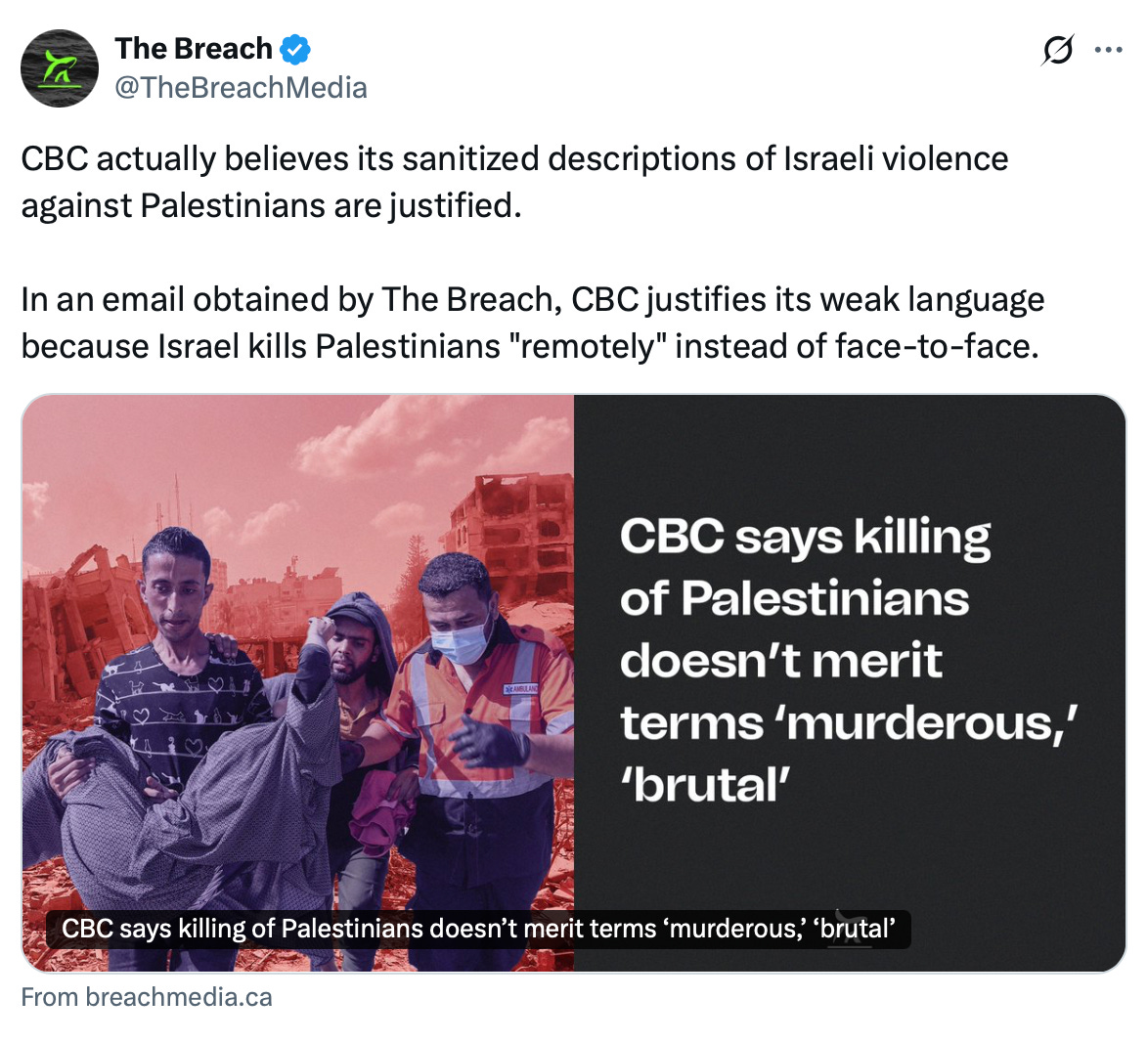
The Breach’s publication of Nancy Waugh’s admission that, to her, airstrikes are palatable is significant because it lays bare the linguistic machinery that sustains this hierarchy of horror. Words like ‘vicious’ and ‘brutal’ are applied to enemies who kill up close, while distant killings get gentler, almost meteorological descriptions, as though bombs were natural disasters that happen to other people in other places. Over decades, the Western public has developed what could be called ‘bombing apathy’: a learned emotional distance that makes it possible to witness mass death without the moral recoil triggered by historical genocide imagery.
The moral error here is obvious. Dismembered is dismembered. Murdered is murdered. The method, blade, bullet, bomb, or gas, does not change the reality of the suffering inflicted or the intent. Airstrikes are no less brutal than gas chambers; in fact, their scale, efficiency, and the absence of psychological limits on the attackers make them capable of far greater destruction. The difference is not in the act, but in the framing, a framing that allows Western states to maintain an image of moral superiority while employing methods that produce horrors equal to or exceeding those we have already defined as genocide.
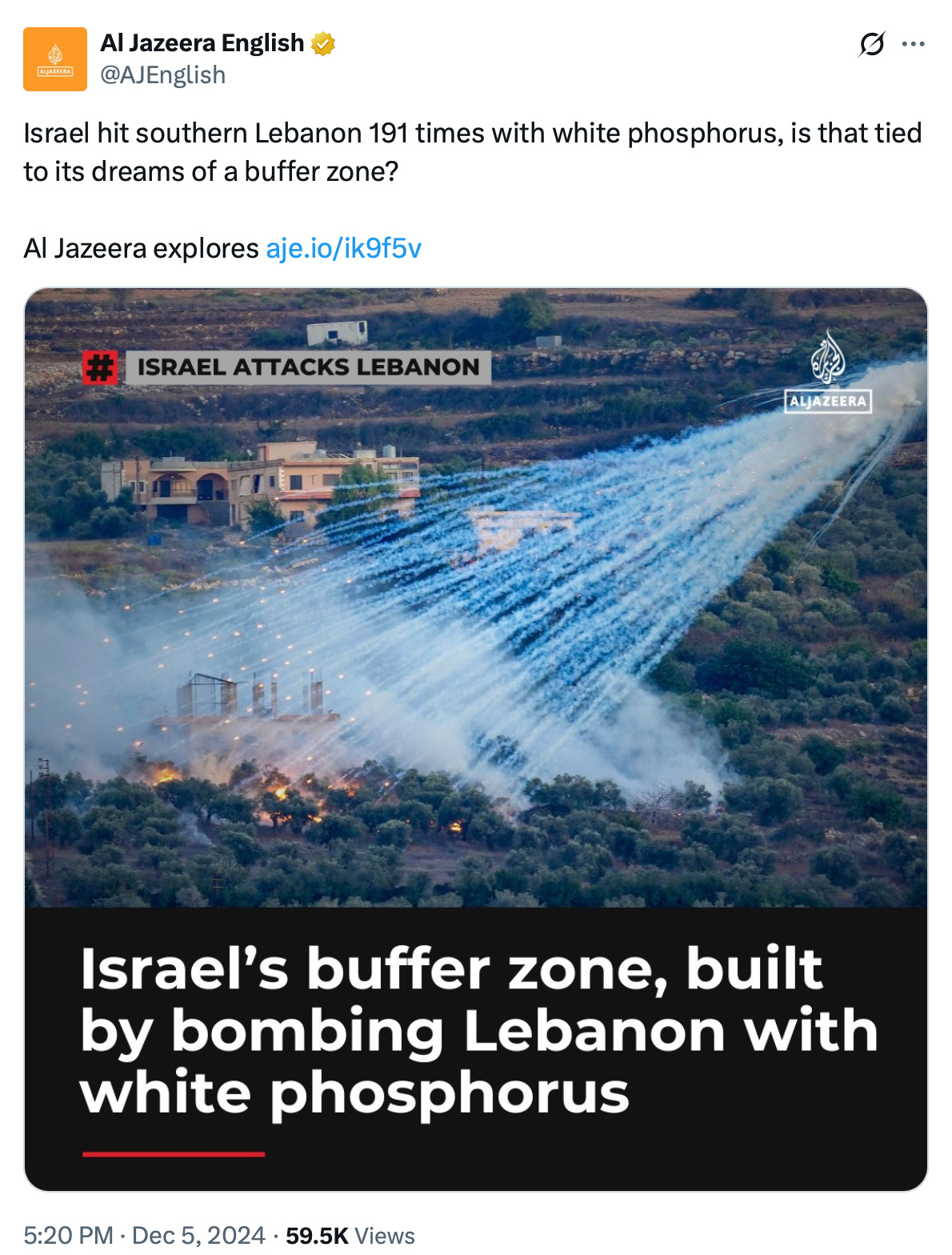
The brutality of modern air campaigns reached an especially grotesque level with the Israeli use of white phosphorus on schools, hospital grounds, and residential areas in both Lebanon and Gaza. When ignited, white phosphorus burns at over 800°C, searing through flesh down to the bone and continuing to burn as long as it has access to oxygen. In Gaza, human rights monitors have documented its use over crowded neighbourhoods, where its glowing shards fall like a rain of fire. Victims are left screaming as the chemical eats through their skin; those who survive bear deep, unhealable wounds that often reignite when exposed to air during medical treatment. The smoke itself poisons lungs, burning and charring from the inside.
These attacks are not quick deaths; they are spectacles of prolonged agony, often carried out where medical aid is already impossible. White phosphorus turns the sky into a weapon that ensures every breath, every heartbeat, is a fresh assault on the body. That such a method can be deployed from a jet and still be discussed as a ‘tactic’ rather than a war crime is abhorrent and exposes the dangerous moral insulation granted by distance and official sanction.
If the gas chamber has become the unquestioned symbol of genocidal brutality, it is only because we have been taught to see it that way and taught not to see the burning, crushing, and dismemberment caused by bombs as belonging in the same moral category. To dismantle this illusion is to confront the uncomfortable fact that the preferred tools of our allies are not morally different from the atrocities we claim to abhor.
See also:


Couldn't have said it better. I'm also fed up of leftits overwhelmingly conjuring the memory of the Holocaust and Nazis to condemn Zionism. On the one hand, the Holocaust is relevant in so far as Israelis are victims turned oppressors. But, on the other hand, it reinforces the idea that only Jewish suffering matters. And while I don't deny that European antisemitism with its bone-chilling culmination in the Holocaust was a major factor behind Zionism, I don't buy that trauma is the sole reason. Enslavement was reserved for Black people during the trans-atlantic slave trade. They suffered for centuries but they didn't produce this ideology of bloodlust.
When I handled Human Rights reports with the New England American Friends Service Committee the activists fighting the Israeli Genocide in Guatemala stated the verb: “ We denounce these acts.” In legalese it shocks the conscience. This video got to me yesterday and your excellent piece above strengthens the horror with White Phosphorus supplied by US Taxpayers:
https://www.globalresearch.ca/video-more-than-100-days-75-years-genocide/5848555