


When I first read Dante Alighieri’s Inferno, I expected fire, brimstone, searing & burning heat. But what I didn’t expect was how orderly it all felt. Hell, in Dante’s mind, is a funnel, its circles tightening and darkening with every level of descent. The Inferno is a moral and ethical architecture, and what struck me most was this: the sins get worse the colder and more calculated they become. That felt like a revelation.
Dante organises Hell in a way that places certain sins above others, some more damning, more painful, and more inescapable than others. This hierarchy doesn’t merely reflect medieval Christian theology like I had expected it to, but it taps into deeper psychological and moral realities. Each level of Hell in Dante's Inferno corresponds not only to a specific sin but also to the way each sin challenges the individual's sense of self, their relationships with others, and their place in the world.
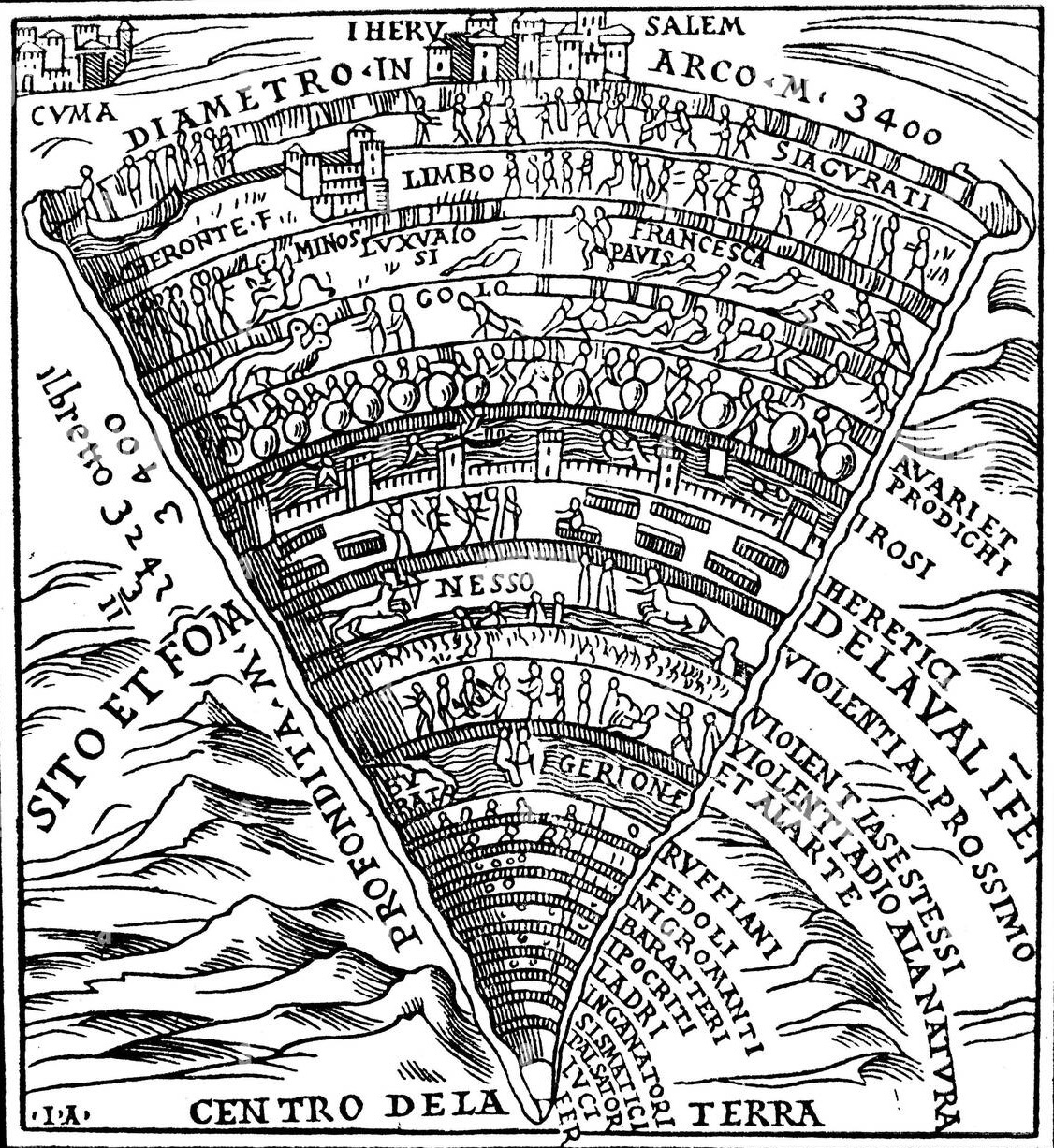
Why did Dante order the sins the way he did? Why is lust punished higher up than fraud? Why is betrayal placed at the very bottom, beneath murder and violence? There’s a logic to it that isn’t just theological. In many ways, Dante was not only a poet and theologian but also a proto-psychologist, intuitively charting the ways in which human beings lose themselves and the path through which they might find themselves again.
Sin
At the core of Dante’s Inferno lies a principle that resonates across most medieval, religious, and even modern psychological perspectives: sin, in its most fundamental form, is the result of a failure to properly align the self with the highest good. In Dante’s worldview, this is God’s divine order. From a psychological perspective, sin can be seen as a deep misalignment of an individual’s expressions (motives and behaviour) with their moral or ethical standard.
But not all misalignments are equal. Some are deep incongruences of personality, while others are more surface-level expressions of misjudgment or momentary weakness. It’s this psychological spectrum that Dante taps into when he places certain sins in more treacherous and torturous circles of Hell than others. His structure actually seems to mirror the psychological concept of moral agency: the capacity to understand and act on moral principles. The more deliberate and intentional the harm, the graver the sin.
Upper Hell: Sins of Incontinence
Lust, Gluttony, Greed, Sloth and Wrath
Dante's hierarchy begins with the sins of incontinence: sins of weakness where individuals act against their better judgment or moral compass. In Dante’s view, these sins are less damaging to the soul than those rooted in cruelty, but they are profoundly painful. The four sins that Dante places at the uppermost circles (lust, gluttony, greed, and sloth) are indicative of the human tendency to indulge in basic, natural desires without consideration for their consequences. In psychological terms, they represent failures of emotional regulation & conscientiousness rather than outright malice and spiritual disease.
Lust is the elevation of physical and sexual gratification above the cultivation of intimacy, mutual respect, or virtue. Psychologically, it can be understood as a displacement behaviour: seeking sensory stimulation as a substitute for or a means of avoiding emotional intimacy or security. This pattern may emerge from attachment insecurities and unresolved emotional wounds. Philosophically, lust represents a distortion of eros, in which the drive for union becomes detached from the pursuit of the good, reducing another person to an object of consumption rather than a co-creator of meaning.
Gluttony reflects an unbalanced relationship with consumption, most obviously in food, but more broadly in the way one approaches pleasure, comfort, and abundance. In psychological terms, gluttony often aligns with compulsive or self-soothing behaviours, sometimes tied to unmet emotional needs, trauma, or the dysregulation of reward systems in the brain. Philosophically, it is an excess that violates the Aristotelian golden mean, mistaking quantity for quality, and treating the satisfaction of appetite as an end in itself rather than a means to support a flourishing life.
Greed embodies an excessive attachment to material possession, power, or status, driven not by genuine need but by a restless desire for more. Psychologically, it is rooted in scarcity thinking: an internalised sense that one is never safe, complete, or valuable enough, leading to obsessive acquisition and control. Greed distorts the relationship between means and ends: it subordinates the pursuit of virtue and communal well-being to personal accumulation, violating the principle that wealth should serve human flourishing rather than define it.
Sloth, often misunderstood as mere idleness, signifies a deeper refusal to act, to choose, or to engage with life’s moral and existential demands. Psychologically, it may manifest as depressive withdrawal, chronic procrastination, or an avoidance of self-confrontation. It can stem from fear of failure, disconnection from purpose, or a paralysing perfectionism. Philosophically, sloth is a neglect of one’s telos: the Aristotelian idea of the inherent purpose of a being, and a betrayal of one’s potential for self-actualisation. In this sense, it is not merely “doing nothing” but a subtle form of self-abandonment.
The Middle Circles: Malice
Wrath, Envy, and Heresy
As the descent continues into Dante’s middle circles, we encounter the sins of malice: transgressions in which the will does not merely yield to impulse but consciously turns toward the harm of others. These sins are more damaging because they reflect a deeper psychological malady: a breakdown in the individual’s relationship with others, a sense of alienation, or a projection of inner chaos onto the external world. They mark a decisive rupture between the rational and social dimensions of the self, recalling the Aristotelian insight that humans, as politikon zōon (political animals), realise their nature through harmonious coexistence, not through antagonism or isolation. These are sins that involve not just weakness, but active hostility and harm.
Wrath is the unbridled surge of anger that subordinates reason to passion, often seeking the destruction, whether physical, emotional, or reputational, of its object. Psychologically, wrath is the culmination of unresolved grievances, humiliation, or chronic frustration, frequently rooted in trauma or perceived injustice. It is sustained by rumination, which keeps the nervous system in a state of perpetual mobilisation. Philosophically, wrath is the antithesis of the Stoic ideal of apatheia (freedom from destructive emotions) and the Aristotelian virtue of praotēs (meekness or gentleness), in which anger is proportionate and guided by reason. Left unchecked, wrath consumes both its target and its bearer, severing the possibility of reconciliation.
Envy is a corrosive fixation on the advantages, successes, or possessions of others, coupled with the wish to see them diminished. Psychologically, envy is linked to low self-esteem, chronic comparison, and the internalisation of unattainable ideals. It may serve as a defence against feelings of inadequacy, externalising self-discontent as resentment toward others. Envy distorts the perception of the good by equating another’s flourishing with one’s own deprivation, a fallacy that denies the potential for shared prosperity. In Dante’s vision, envy blinds both literally and metaphorically, for it clouds the moral imagination, rendering a person unable to perceive the intrinsic worth of their own existence.
Heresy represents an intellectual break from a unified worldview. In Dante’s moral topography, heresy is not simply doctrinal disagreement but the willful rejection of a unifying truth that orders life toward meaning and coherence. Psychologically, heresy can be understood as a radical cognitive dissonance: the conscious or unconscious need to reject inherited frameworks, even at the cost of existential fragmentation. For some, this may emerge from disillusionment or betrayal by institutions, leading to a reactive embrace of beliefs that disrupt rather than heal. An exile not only from community but from an integrated self-understanding.
The Deeper Circles: Betrayal
Fraud, Treachery, and the Loss of Self
In the deepest and coldest recesses of Dante’s Inferno, the sins of fraud, treachery, and betrayal take form: transgressions that signify not the momentary weakness of incontinence or the heated malice of wrath, but the cold, deliberate choice to violate trust and distort truth. Here, will is not overpowered by passion but is actively enlisted in the service of calculated harm. These sins are markers of a fractured moral identity: a disconnection from conscience so complete that empathy becomes subordinate to manipulation, and integrity is sacrificed to self-interest. These sins represent the perversion of reason itself, using the faculty meant to discern the good as an instrument to undermine it.
Fraud is the intentional use of deception to manipulate others for personal gain. It is a crime of intellect rather than impulse, requiring foresight, calculation, and an awareness of the moral law that is consciously set aside. Fraud often arises from narcissistic entitlement, Machiavellian tendencies, or chronic insecurity masked by control over others’ perceptions. It thrives on the exploitation of trust, bending reality into a shape that serves the deceiver’s ends. Philosophically, fraud is the antithesis of truthfulness, one of the cardinal virtues in both Aristotelian and Thomistic ethics. It violates the shared symbolic order, language, promises, and mutual understanding upon which human community depends.
Treachery is betrayal in its most intimate form: the turning against a friend, a person who has given trust, love, or loyalty. Unlike fraud, which may target strangers or institutions, treachery corrupts the very foundation of personal relationship. It is rooted in a capacity to suppress empathy in favour of self-preservation, vengeance, or ambition. It may involve pathological detachment, the rationalisation of harm, or an ingrained belief that loyalty is expendable when weighed against personal advantage. Philosophically, treachery is the inversion of fides (faithfulness) an ancient and sacred bond without which society cannot exist. It is a rebellion not only against another person but against the relational fabric that makes one human. In Dante’s vision, it is the ultimate estrangement: the self sealed away from love, warmth, and the possibility of redemption.
The treacherous souls that Dante places at the very bottom of Hell, those who have betrayed, are condemned to an eternal, unyielding frost. Betrayal, according to Dante, represents a profound internal fracture, a total disavowal of the self, a severance from one’s values, and a rejection of the possibility of redemption. The frost and ice characteristic of this deepest circle of hell captures this emotional and spiritual paralysis, where the soul is encased in a state of perpetual isolation, cut off from the warmth of love, hope, and reconciliation.
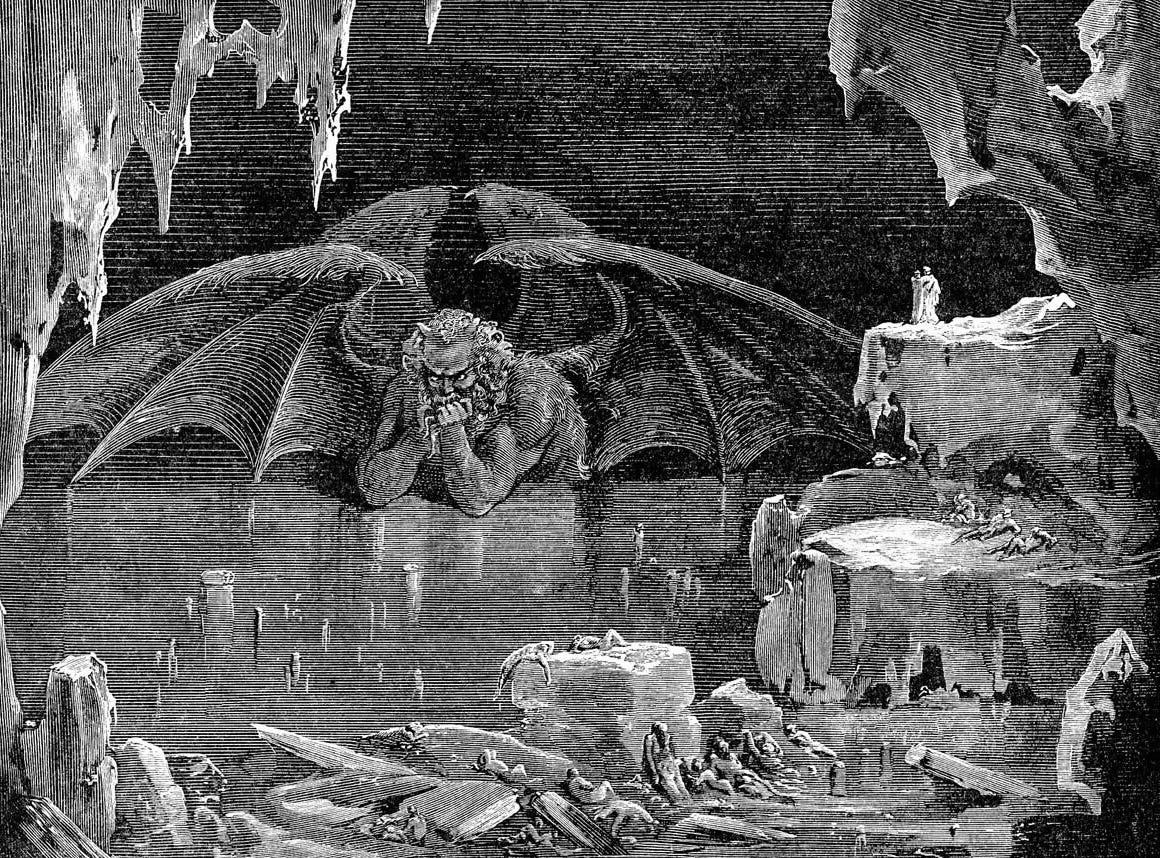
What strikes me most profoundly in Dante’s Inferno is not the biblical code and the severity of the punishments, but the underlying psychological commentary on the ethical health of the soul. True warmth is felt when we are attuned to others and ourselves. We lose that warmth as we rupture our connections to the rest of the world. The further we isolate ourselves through sin, the colder our reality becomes. Hell, in Dante’s vision, is not just a place of suffering; it is a psychological landscape that reflects the inner turmoil of the human condition.
Dante’s revelation is that the path to redemption is through self-awareness and self-correction. The deeper the sin, the more distant one becomes from divine order, but this also means the possibility of reconnection becomes more arduous and complex. Dante’s journey is, in a sense, the journey of psychological integration. The sins in Hell represent the fragmented parts of the self, and the downward journey is a path to confronting the dissonances that exist within.


Thanks for this. I was also struck by how the sins grew more deliberate, considered, and more coldly calculated during the descent as you have nicely elaborated. Reading the footnotes in the version I read, also clarifies how he was responding to the politics and many deliberate corruptions, religious and otherwise, in those restless worldly turnings. And then he universalized it while also highlighting many specific personalities he explicitly or by allusion placed therein in a kind of literary vengeance or conviction about the damage of their actions. His generalities or universalism are fascinating, while some of the specific personalities he binds to these universal condemnations shows how, for all his wisdom, he was a man bound to and unable to escape the prejudices and misinformation of his times. He succeeds in the universal truths, but often shows the limitations (by his own human tendency to error) that can influence even the strongest most brilliant literary minds.
This is one of the best articles of yours I’ve read! It was truly eye opening for you to break down each cardinal sin from a psychological perspective.