

The Settler Keeps Alive in the Native an Anger Which he Deprives of Outlet
A Look at Frantz Fanon's Clinical Understanding and Treatment of Colonised Peoples Who Were Denied Their Own Anger to the Point of Pathology

Fanon once wrote that “The settler keeps alive in the native an anger which he deprives of outlet.” It wasn’t a metaphorical notion but his clinical observation. He was describing what occurs when a biologically grounded and socially necessary human capacity (defensive anger) is deliberately provoked and then structurally immobilised. To enrage, and then to seal off every avenue through which that rage might find form, release, or meaning. Nowhere can this be seen more plainly at the present moment than in, and in relation to, Gaza.
First I must stress that anger is not, in and of itself, an ethical failure or an emotional excess. When stripped down to its evolutionary psychological function, anger is simply a coordinated mobilisation of an organism. It is as fundamental as fear or attachment. The expression of anger emerges when boundaries are violated; when the integrity of the body, the individual, the family, or the community is threatened. It mobilises defence. It sharpens perception. It sends an unmistakable message: a boundary has been crossed, and further intrusion will be met with force. In this sense, anger, in and of itself, is not necessarily opposed to reason; it is one of reason’s oldest instruments. A population incapable of anger in the face of dispossession would not be peaceful, it would be extinguished.
Under colonialism, anger is neither resolved or allowed expression; it exists in a state of chronic suspension. Interestingly, the coloniser often does not even attempt to eliminate anger in the colonised. In fact, the colonised person’s anger becomes narratively useful to the settler. Its distorted expressions are captured as confirmation of the settler’s own mythology: that the native is irrational, savage, barbaric and in need of discipline, correction, or eradication. What colonial domination first produces, it then points to as justification. It cultivates the rage while ensuring it cannot fulfil its defensive role. The native is humiliated, expropriated, surveilled, beaten, and insulted, but any attempt to respond is labelled criminal. It is astonishing to me how plainly the early European colonisers of Palestine, for example, acknowledged this as a matter of fact.
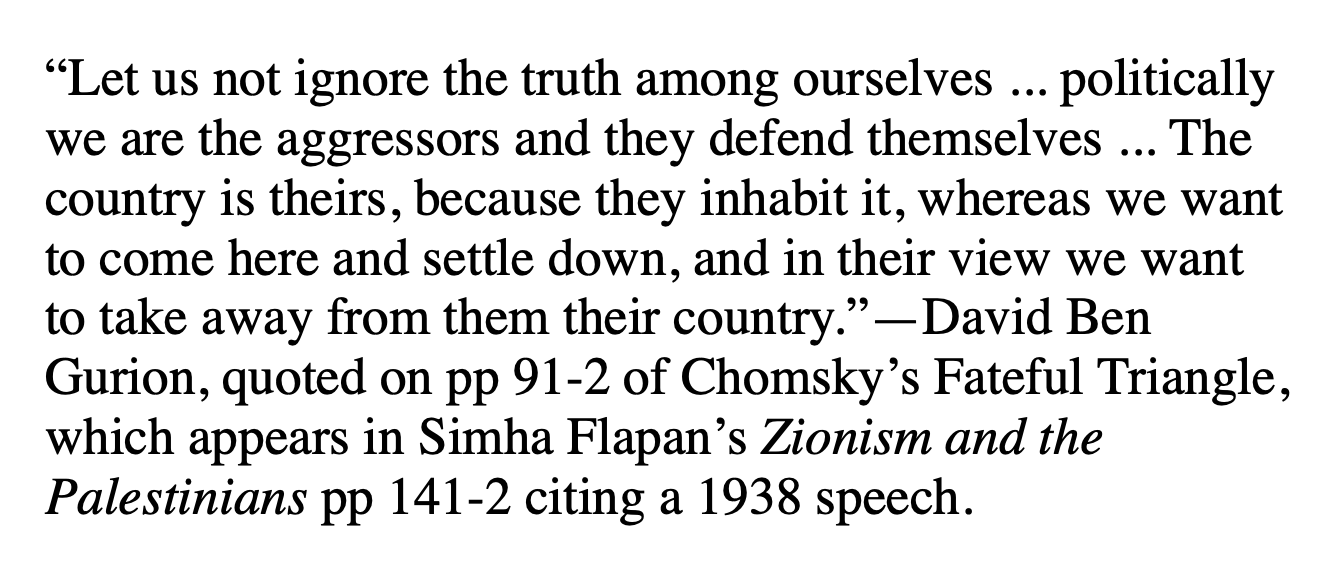
The settler produces the stimulus for anger while monopolising all legitimate means of acting upon it. Strikes and assemblies are banned; legal redress is blocked through military courts and administrative detention; peaceful marches are banned with military force; and then, when resistance turns violent after every civil avenue has been sealed, that violence is invoked as proof that repression was necessary all along. Negotiation with these people is obviously futile because they are born and raised ‘terrorists’ and ‘fanatics’. It is a methodological and refined cruelty. Anger is allowed to exist only as affect, never as force.
For a moment, consider with seriousness what it means to be born in Gaza. You enter the world already enclosed by fences, walls, and a naval blockade you did nothing to earn and cannot escape. Your future is not discovered gradually; it is pre-emptively narrowed. Movement is restricted long before ambition can take shape. Travel is not a right but a rare and revocable permission. Education offers knowledge without corresponding opportunity. Unemployment is not a personal failure but a statistical likelihood. Food insecurity is chronic rather than exceptional. Electricity arrives intermittently, clean water sporadically, and medicine conditionally. The sky itself is a source of anxiety, not weather. Then, strikes take out your apartment block, often in the early hours of the morning, when families are asleep, reducing your home to rubble in seconds. There is little warning, sometimes none at all. You run if you can, carrying children half asleep, unsure whether the next explosion will land where you are standing. By daylight, the dead are counted: neighbours, parents, your children, your siblings. Those who survive sift through debris for documents, clothing, bodies. Rescue is improvised, delayed, or impossible.
What kind of human response would we call sane if not anger? If not blinding rage?
Psychotherapeutically, if a mother mentions the molestation of her daughter, the violent death of her son, the burglary of her home, the infidelity of her husband, anger is not a symptom to be managed away. Anger is something I would expect and would want to see emerge in the room as evidence that reality has been registered correctly, that the ego is healthy and functioning. It is a sign of sanity. The absence of anger in such moments would be far more clinically concerning; a sign of dissociation, collapse, or injury to the self. Anger at our own injustice is intelligible and grounded in reality. It arises from a moment of clear injury and seeks acknowledgment, protection, or justice. The colonised native is suspended perpetually at the point of injury, of humiliation, of pain, denied the human dignity of release. Fanon describes this chronic state of mobilisation in bodily terms as muscular tension, nervous agitation, stammers, shaking, and explosive dreams. The individual is prepared for defence, yet forbidden to defend themselves. Over time, this contradiction becomes a psychological pathology. Anger, deprived of its natural trajectory outward toward the source of injury, turns inward or laterally.
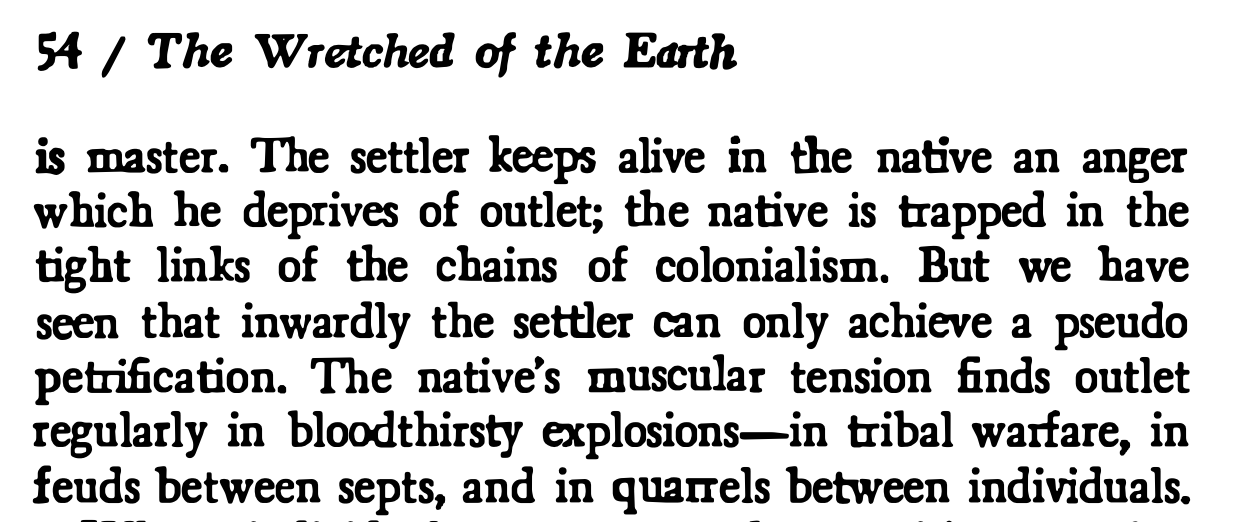
Fanon’s clinical observations during his time in Algeria are pretty brutal and unfortunately closely consistent with my recent encounters with mental health patients from Gaza. Fanon describes how the anger deprived of outlet erupts in domestic conflict, inter-communal rivalry, ritualised aggression, and self-destructive behaviour. The colonised man beats his wife and resents himself for it, not because he is inherently brutal, but because the structure of power has made the true enemy unreachable. Anger becomes destructive when it is denied its rightful object. The body still demands discharge, the psyche still seeks equilibrium. When political action is foreclosed, pathology becomes the substitute.
This is why Fanon rejects moralising interpretations of colonial violence. To condemn the colonised for misdirected aggression without examining the system that blocked its proper outlet is, in Fanon’s view, another form of colonial mystification. The settler benefits twice: first by provoking anger, and second by pointing to its distorted expressions as proof of native inferiority. Rage is elicited, sabotaged, and then cited as evidence.
Fanon’s Clinical Cases
In the closing chapter of The Wretched of the Earth, Fanon abandons abstraction and writes as a clinician. What he writes is not illustrative or symbolic, it is diagnostic. The case studies are Fanon’s final argument. They demonstrate, with a horrible clinical sobriety, what sustained colonial violence does to the psyche when injury is repetitive, intimate, and structurally unanswerable.
The first case Fanon describes is regarding the sudden and persisting impotence in an Algerian man following the violent rape of his wife by French colonial soldiers. Crucially, there was no prior history of sexual dysfunction; the symptom appeared directly after the assault and resisted all conventional treatment.
Fanon’s interpretation was not psychosexual in the narrow Freudian sense. The impotence is not guilt, repression, or latent neurosis. It was a complete collapse of symbolic and bodily authority produced by total powerlessness. The patient had been forced to witness the absolute violation of his family, of those explicitly under his care and provision, without any possibility of defence, retaliation, or justice. He was rendered incapable of fulfilling even the most basic social role, protector, not because of personal inadequacy, but because the colonial structure made protection impossible.
His body registered this impossibility before language did. Sexual function, which presupposes agency, desire, and continuity, became untenable. Impotence here was not a private pathology; it was the somatic inscription of political humiliation.
Across multiple clinical cases, Fanon describes treating patients suffering from chronic insomnia, panic attacks, tremors, and chronic bodily pain with no organic cause. These patients lived in a state of constant anticipation, waiting for arrest, interrogation, disappearance, or bombardment. Their nervous systems were locked in a state of permanent alert. Fanon is explicit: these are not ‘war neuroses’ in the conventional sense. Unlike soldiers who can act, retreat, or discharge aggression outward, the colonised civilian is entirely immobilised. Fear and anger are chronically activated but never resolved. The result is what we would now recognise as severe trauma compounded by helplessness, an organism perpetually mobilised with nowhere to go.
Fanon also documented cases of acute psychosis; hallucinations, paranoid delusions, dissociation, even emerging in civilians with no prior psychiatric history. These breakdowns often followed episodes of extreme violence or prolonged exposure to terror without relief. In another heart-wrenchingly memorable case, Fanon treated a young man who was seized by recurrent, obsessive fantasies of homicide after surviving a brutal mass execution of his village. Twenty-nine Algerian men were shot in the head and chest at point-blank range by French colonial forces in front of him, and then he was shot twice in the arm and leg. He laid for hours among the dead bodies of his neighbours. Brutal complex, compound trauma. Below are Fanon’s chosen extracts from his statement that highlight the patient’s acute paranoid psychosis.
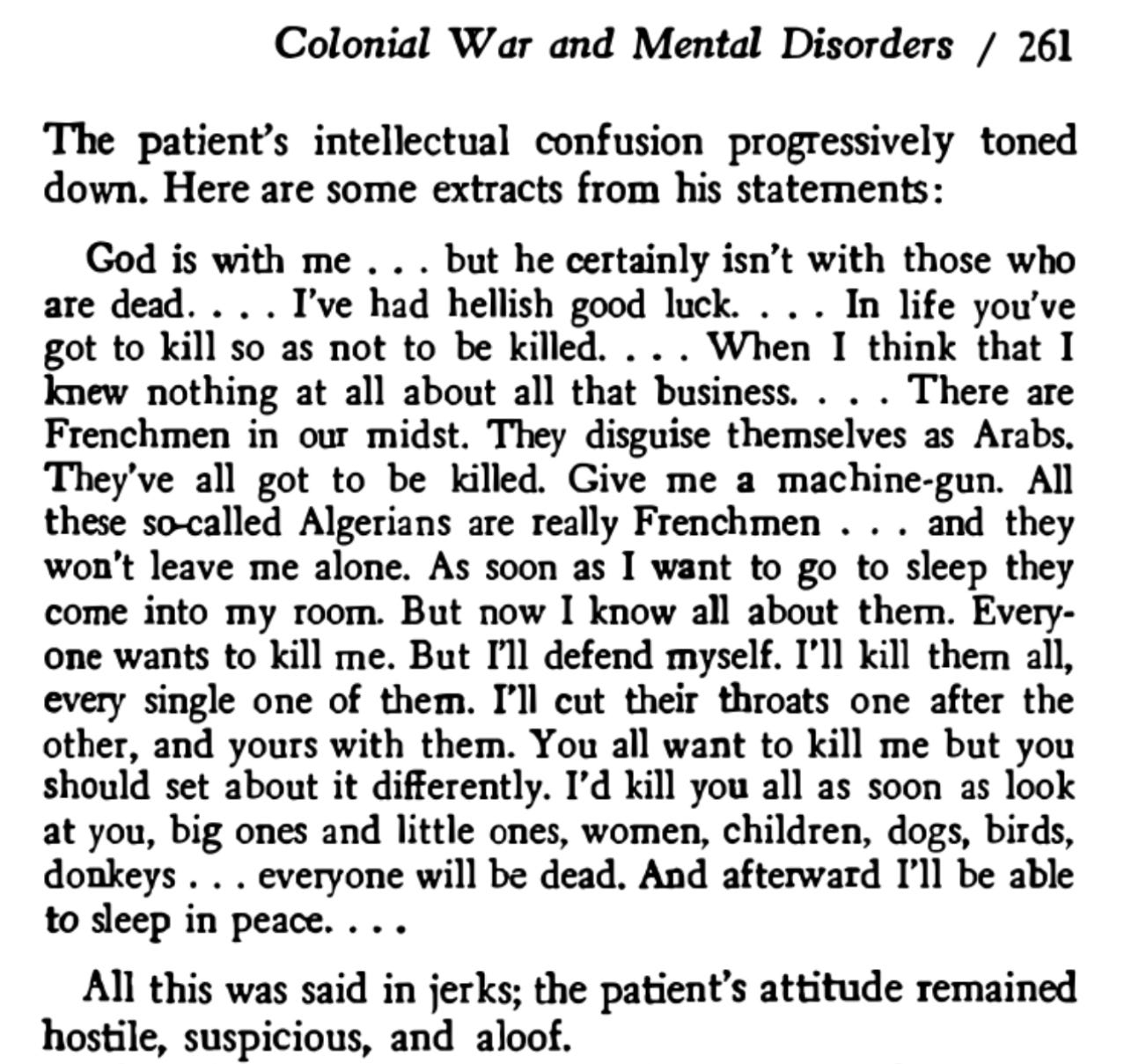
What is remarkable to me is Fanon’s refusal to see these cases as individual abnormalities or pathologies. He situates each and every one within the colonial structure itself. He insisted that they were rational responses to an irrational environment. When reality itself became unpredictable, lawless, and lethal, the mind fractured not because it is weak, but because coherence had been made impossible. Insanity in an insane environment is the only sane response.
Colonialism produces mental illness. Not metaphorically, not indirectly, but clinically. Symptoms emerge precisely where agency is destroyed, where anger is justified but forbidden, where defence is necessary but impossible. These patients were not failing to adapt. They were adapting exactly as a human nervous system does when trapped in sustained violation without outlet or escape.
Decolonisation, in Fanon’s account, is therefore not only political and social restructuring. It is the reorientation of anger back toward its legitimate target. This is why he insists that decolonisation is experienced as a ‘psychic rupture’. For the first time, the colonised subject’s anger ceases to be diffuse, shameful, or self-lacerating. It has direction. Whatever one may make of Fanon’s controversial endorsement of violence, it cannot be understood apart from this claim: that psychic health requires the possibility of effective defence. An anger that can act is no longer pathological; it becomes organising. An anger that recognises its source threatens the entire colonial architecture.
Colonisation is as Much a Psychological Project as it is a Political One

There’s a kind of violence that doesn’t mutilate and disfigure the bodies of its victims but disfigures the mind; it is quiet, corrosive, and generational. Frantz Fanon, the psychiatrist and anti-colonial theorist from Martinique, understood this better than most. Fanon is, in my opinion, the most compelling thinker when it comes to understanding the ps…
thank you for writing this. it's very important work. i especially appreciate the lens of evolutionary psychology that you apply to anger as an emotion.
This thing applies to Gaza on a one to one basis. Israelis are also a perfect Fanonian case study in that sense.