

Raise Children that can Trust You and Themselves
Fostering a Sense of Self-Efficacy and Emotional Maturity Through Everyday Interactions with a Child

Children initially learn how to operate socially and introspectively from observation. This has been repeatedly shown in volumes of robust research. On the social front, children learn how to interact with others in the domains of play & leisure, compromise & sacrifice, conflict & reconciliation, and patience & boundaries from observing how those things operate in the home. The parent-parent interactions we witness growing up also inform our blueprint for love. How we are most inclined to function in adult romantic relationships, particularly during moments of high-stress conflict, is deeply rooted in how conflict, reconciliation, differences, affection, and honesty were approached between our mother and father during childhood. That is the social dimension.
On the introspective front (the child’s developing relationship with themselves), it is primarily in the parent-child interactions where we form and modify our self-perception. ‘‘The self comes from the other,’’ maintained Hegel, highlighting that even our most intimate and personal quality, our very own sense of selfhood and identity, does not emerge ‘from within,’ but rather from our dialectic engagement with a social landscape. We draw up the initial drafts of our self-image and all of our assumptions about who we are, what we need, what we’re good at, and what we’re bad at in the context of relationships; namely, the parent-child relationship. How lovable I am, how interesting I am, how funny I am, how intelligent I am, how reliable, how competent etc. That is all information we internalise relationally based on how our parents react to our behaviour.
To demonstrate how the parent-child relationship can inform an aspect of a child’s self-image with a single interaction, here is a scenario:
A child is desperate for a trip to the toy shop and asks their mum repeatedly to take them. The child is unaware that, today, mum had an explosive argument with her sister and that she has 3 assignments overdue at work and that she just found out they are all out of toilet roll at home. Mum snaps in response to the child and yells at the child to ‘Go to your room and leave me alone’. As explained in The Miracle of Motherhood in Developmental Psychology, children are inherently narcissistic and view everything through the lens of the self. It is not in a child’s nature to consider the possibility that what mum just did was not because of me, but because of something else. Thus, what the child concludes in this case is that mum does not want me around, she does not love me, I am unlovable and annoying.
With no follow-up reparative conversation with mum, the child is left alone to affirm and internalise the self-loathing narrative created by the child’s mind. The long-term results of such a self-perception are well documented in research (low self-esteem & sense of self-efficacy, dysfunctional relationships, imposter syndrome etc). Children intrinsically look to parents for the fulfilment of their every need, including their most primitive survival needs. Parents are a primary source of security and safety for children. If you have ever observed a child playing in a public park, you will notice that every 5-15 minutes the child will habitually glance back to wherever their parent is sat. Children are natural explorers and adventurers but even in their most playful state, they require consistent reassurance that, should anything go wrong, their source of safety is nearby. Thus, when a parent shouts, yells, or threatens their own child, what happens in the mind of a child is that their sole source of safety and security has become their immediate source of danger and threat. There is nothing more devastating to a child than that. A child is left alone to doubt their own experience and potentially face the reality that they cannot trust their parent.
It’s important, at this point, to state that parent-child interactions like the one exemplified above are incredibly common and even the greatest parents are still fallible. What matters most is not always the initial interaction (shouting, yelling etc), but what follows it. The mum in this scenario has an opportunity to not only prevent the internalisation of the child’s negative self-perception, but also to teach her child accountability in the most effective way possible.
The intervention must provide a clear separation between the mother’s behaviour and how she feels about the child:
“I want to apologise to you for how I acted earlier. I shouted at you and that was an overreaction. You do not deserve to be shouted at. I also told you to leave me alone which is hurtful and not how I really feel. I love you so much and I always want you around me. I will learn to express myself in better ways when I am upset.“
The child learns two things here: (1) mum’s outburst was about her and not about me—she still loves me, and (2) It’s good to be accountable for my behaviour and my actions have a direct impact on other people. Children learn accountability from parents who make a point to repair after hurtful or dysfunctional behaviour.
Parents are the most easily accessible models a child has to imitate. Every interaction a child witnesses between adults—whether it’s a conversation with a neighbour, a disagreement with a spouse, or a moment of laughter among friends—becomes a template for how to approach similar situations. However, children are also highly attuned to the inconsistencies they observe between what adults say and do. They look to their parents not just for guidance but also as examples of integrity and consistency. When you consistently model honesty and accountability, it cultivates not only a child’s trust in you, but a deep trust in themselves. Children are really not seeking perfection in their parents; they are seeking authenticity and unconditional love.
This is such an important message. Raising children to become confident adults is a big responsibility and a challenging task. Thank you for your tips.
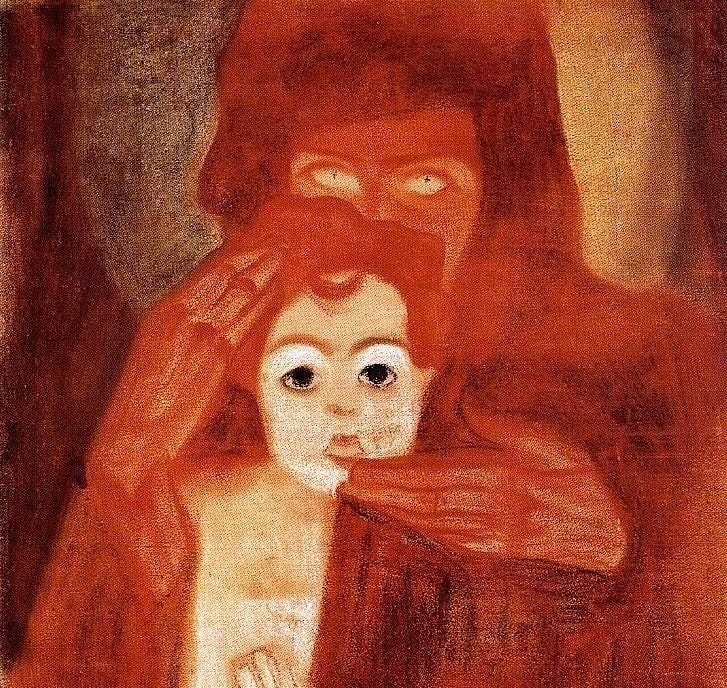
Yikes, that art piece is spooky! Where do you even find these pieces?
Execellent post. Really love the bit about the follow-up and how that ultimately shapes the child and parent child relationship more than the initial reaction.
I think there's much comfort and motivation therein, knowing that owning upto your own mistakes is the biggest way to positively impact your child and impart those values onto them, in a way that will stick a millions times better than telling them they should "apologize" if they do xyz.