

Maternal Psychology is Nothing Short of Miraculous
How Female Psychological Sex Differences Facilitate The Most Profound Relational Process Imaginable: Mother-Infant Attunement

The vocation of a mother is incredibly elaborate. It is, for me, the most fascinating hallmark of our species. Setting aside the physical marvel of pregnancy and childbirth, the distinctive psychological architecture of a mother is, in itself, nothing short of miraculous.
The phenomenon begins with the birth of an utterly helpless human infant. At birth, we are entirely dependent on our primary caregivers (typically mothers) for every element of our survival and development. Our mothers become immediately responsible for the fulfilment of every single one of our physiological and psychological imminent needs. On the physical side: the provision of food, water, hygiene maintenance, and health maintenance. On the psychological side: company, soothing, touch, affection and praise.
Now this is where it gets complex. Infants have one singular method of communication: to cry/moan. Every single one of their distinct needs is communicated by the infant in exactly the same way to the mother. Mothers, therefore, have to be incredibly intuitive to decipher from body language, facial cues, and perhaps even elements beyond physical awareness, what need their infant requires fulfilment in that particular moment.
What comprises the foundations for this kind of intuition? How does a mother come to possess it? Could a man ever simulate it?
The Maternal Dimension of Female Personality: Agreeableness & Neuroticism
To understand the beauty of the female personality and its maternal dimension, we should first establish how human personality and its sex differences are mapped in the research. It is a fact that, temperamentally, the average man differs from the average woman, and these differences manifest most plainly at the extremes. For example, men are generally more aggressive than women. That is not to say that there are not aggressive women out there who could outmatch and overwhelm a temperamentally average man; however, at the extreme, 100% of the 100 most aggressive people alive are men, and 100% of the 100 least aggressive people alive are women.
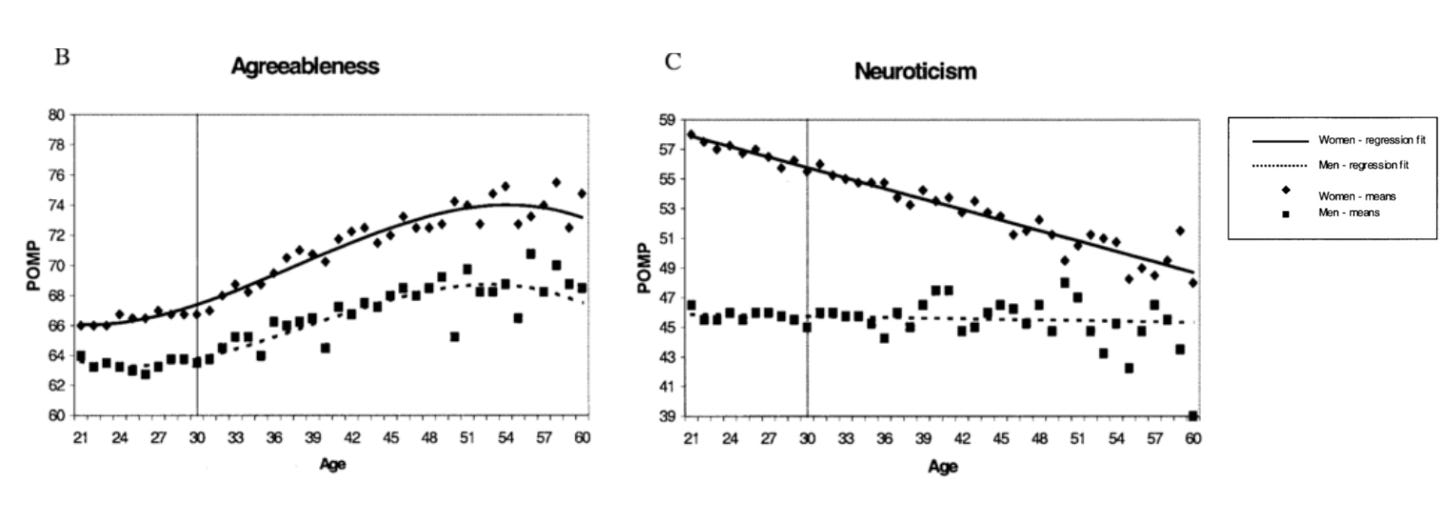
A clear expression of these sex differences as it pertains to maternity can be seen with two of the Big Five personality dimensions. Women generally score in the highest percentiles for trait Agreeableness and for trait Neuroticism, while men do not.
Agreeableness
Agreeableness is characterised by elevated levels of compassion and cooperation, making it the core dimension of caregiving in an individual’s personality. It is a willingness to listen, a preference to cooperate, an aversion to conflict, and a curiosity to understand the ‘other’. Agreeableness is a pathway structured for the building and maintenance of deep relational connections. It enables the formation of intimate bonds and the process of emotional attunement in relationships that ultimately become the cornerstones of a healthy functioning society (parent–child, teacher-student, husband-wife, neighbour-neighbour, doctor-patient). Women are, on average, significantly more agreeable than men.
The neurobiological model proposed by Allan Schore offers a fascinating explanation for how this compassion and responsiveness in a woman (the hallmarks of agreeableness) results in profound right‑brain attunement between mother and infant. Schore shows that the infant’s ‘right brain’, the seat of emotional, non‑verbal, and attachment processing, develops through its earliest, finely tuned exchanges: facial expressions, vocal tones, gestures, and touch. These moment‑to‑moment synchronisations (what he calls ‘affective synchrony’) are essential for expanding the infant’s regulatory systems and shaping its emerging self.
When a mother high in agreeableness engages with her baby, delivering warmth, empathy, and gentle responsiveness, these interactions act as a scaffold for the infant’s emotional brain to grow optimally. Her emotional presence helps to create a rhythm of reciprocity: the infant cues, and she intuitively responds, restoring equilibrium. A mother high in agreeableness is willing to go (emotionally)where the infant leads. Over time, these right-brain mediated exchanges form a secure attachment, enabling the infant to self-regulate and feel deeply seen.
Effectively: (1) infant begins to cry in distress, (2) mother observes and unconsciously moves to emotionally sink to the infant’s emotional state and mood to meet it there, (3) infant is met and joined by mother in mutual distress and attunement takes place, (4) mother then begins to lift her own emotional state out of distress, (5) infant, now attuned to mother, unconsciously follows mother into a more positive emotional state.
It is remarkable.
Biologically, this attunement is further facilitated by the distinctive expression of particular hormones in mothers as opposed to fathers. The caregiving roles of mothers and fathers are underpinned by distinct, but complementary, hormonal systems. Mothers, following pregnancy and birth, experience surges in oxytocin and prolactin, hormones that foster nurturing behaviours, affectionate touch, emotional attunement, and verbal and audible affirmations. Oxytocin in the maternal brain produces behaviours like prolonged gazing, soft vocalisations, and soothing contact.
Fathers, meanwhile, also show increases in oxytocin, but their expression is distinct from that of a mother’s. A father’s release of oxytocin is associated with stimulatory contact, cooperative problem solving, and play, enhancing affectionate yet active engagement during interactions. Research even suggests that after childbirth, a father’s oxytocin elevates activity in brain regions tied to reward and empathy, especially when seeing their own child, reflecting a particularly unique neural attunement through affectionate involvement. Additionally, fathers experience a surge in vasopressin, another neuropeptide, which supports more assertive, ambitious, protective behaviour and social communication. Together, these divergent hormonal pathways illustrate how maternal and paternal instincts are naturally shaped, one oriented toward nurturing emotional closeness, the other toward playful bonding and protection.
Neuroticism
Neuroticism is the dimension of personality that refers to an individual’s sensitivity to negative stimuli and emotions. Similarly to trait agreeableness, on average, women score significantly higher in trait neuroticism than their male counterparts. Individuals high in trait neuroticism will pick up on subtle emotional cues that others might miss: a slight shift in tone of voice, a fleeting expression of discomfort, the furrow in a person’s brow, or a sudden change in body posture. The observations will elicit in the individual a heightened emotional state to provoke an emotional response. This neuroticism is also a feature of the maternal dimension of female personality. Women are the sex that birth and immediately care for infants and so a more neurotic temperament proves incredibly useful as a threat detection system.
Aside from infant care, women have a number of good reasons to be more sensitive to negative stimuli than men; for example, women are more physically and sexually vulnerable than men. A woman will identify a change in tone, or a change in body language, or a hazard in the environment, or a hesitation in their significant other, and these will make an emotional impression on her. In a marriage, a woman will bring her partner her concerns (the threats she has detected and her current understanding of them), and the intention and goal of that interaction is to: 1) regulate and resolve the emotional impression left by the trigger, and 2) to gauge the validity of her concern using her husbands assessment.
However, a man’s typical reaction to his partner’s emotive concerns are twofold: (1) to try to contain and minimise her emotional expression of the concern (e.g. stop the crying) but in doing so dismissing and neglecting to address the threat his partner has detected, or (2) immediately problem solve to either negate the threat as valid or remove it entirely from the situation. If a man is able to listen to his partner’s entire description of the issue with curiosity, and let the discussion unfold to the degree that he begins to understand her perspective well enough to offer a solution, then his legitimate assessment of his wife’s concerns will be received by her as genuine comfort.
It is important to note that, like any thorough threat detection system, a woman will produce a number of false positives. She may have picked up on a subtle cue that is does not actually represent a serious concern, or a threat that will not actualise, or perhaps she has interpreted an unusual but harmless gesture as threatening. Women initiate roughly 75% of divorces in the West. The driving factors for this statistic are debated; some choose to conclude that women must simply be troublesome; however, I think it is much more likely the case that, generally, women pick up what’s wrong in a relationship long before men do. Therefore, husbands would do well to listen and facilitate exploration of their wives’ concerns.
To return to how these traits facilitate the maternal dimension of female personality, agreeableness and neuroticism, when nurtured, they result in a functional source of real intuition. Meaning, the majority of the time, an infant communicates a need (by crying monotonously), a mother’s intuition will allow her to correctly identify and fulfil it. However, nobody is infallible. Mothers are simply imperfect human beings living life for the first time. An infant’s desire for physical affection and comfort may easily be mistaken for hunger. No mother is going to be able to accurately identify and immediately fulfil every need communicated correctly every time. Therefore, every child will be left with unmet psychological needs at some point, resulting in what is now referred to as a '‘childhood wound’. The consistency with which a child’s needs are neglected or misinterpreted by their primary caregivers is what creates the blueprint for the development of personality structure and adult attachment styles.
However, I encourage caution against catastrophising the concept of ‘childhood wounding.’ The aim is not to be a ‘perfect mother’ without fault. The British paediatrician and psychoanalyst Donald Winnicott famously coined the term ‘Good enough mother’ to describe the kind of caregiving that supports healthy psychological development without requiring perfection. Winnicott observed repeatedly that infants do not benefit from having every need met instantaneously and flawlessly; rather, a mother who is ‘good enough’ initially adapts closely to her infant’s needs, providing reliable comfort, attunement, and care. Over time, however, she allows for small, tolerable frustrations by occasionally misreading a cue or not responding instantly. These minor lapses, far from being harmful, help the infant gradually develop resilience, frustration tolerance, and the ability to self-soothe. In this way, maternal imperfection becomes an essential developmental gift, training the child to exist in a world where others cannot, and will not, always meet their needs on demand. Winnicott’s insight reframes maternal fallibility not as a failing, but as a natural and necessary part of fostering a secure, autonomous, and emotionally capable human being.
Child Narcissism
The catalyst for this hurdle is the inherent narcissistic nature of children. I use narcissism here to describe the failure of children to distinguish the self from external objects, and not in the negative and dysfunctional sense. Children view everything external and environmental through the lens of the self. When mum leaves a cuddle to take a serious phone call, an infant interprets that as a fault of their own: “I did something wrong, mum left me“. When mum and dad burst into an argument in front of an infant, the child interprets that as a fault of their own: “Mum and dad don’t love me or each other anymore, I did something wrong“. Conversely, when mum randomly comes into the toy room smiling to play with their child, the child also interprets that, again, through the lens of the self: “Mum loves me, I’m fun to play with, I’m interesting“.
Our earliest interactions with our primary caregivers, particularly our mothers, sculpt our self-perception, self-esteem, and sense of self-worth. They also inform our blueprint for romantic love. How we operate in adult romantic relationships, particularly during moments of high-stress conflict, is deeply rooted in how conflict, reconciliation, affection, and honesty were approached during childhood. Motherhood is, therefore, not only intuition, it is sacrifice. The momentary satisfaction of escalating a household conflict to get a point across is sacrificed by a mother who wants to model healthy resolution and calm communication. The inherent and existential human yearning for autonomy is sacrificed by mothers to indulge and satisfy the narcissistic temperament of their child. The physical comfort of a mother is sacrificed for nine months prior to and years post childbirth for the physical development of her infant child.
When phrased plainly, it’s a baffling job description. Mothers sacrifice their physical health and personal autonomy to sustain and immediately obey each and every specific command from a self-centred, unempathetic and unforgiving little creature who will offer no gratitude or appreciation. Why do they do it? I can explain it partially as a psychological and physiological phenomenon through hormone changes and instinctual psychological drives. However, the largest part remains intellectually unexplainable to me, suggesting that there is some sort of metaphysical component. Perhaps you now share my fascination with the miracle of motherhood. Pure, unpolluted love. Complete emotional investment. Inexhaustible and unconditional empathy and patience. Magic.
References
Carter, C.S., 2014. Oxytocin pathways and the evolution of human behaviour. Annual Review of Psychology, 65, pp.17–39.
Feldman, R., Gordon, I., Schneiderman, I., Weisman, O. and Zagoory-Sharon, O., 2010. Natural variations in maternal and paternal care are associated with systematic changes in oxytocin following parent–infant contact. Psychoneuroendocrinology, 35(8), pp.1133–1141.
Schore, A.N., 2001. Effects of a secure attachment relationship on right brain development, affect regulation, and infant mental health. Infant Mental Health Journal, 22(1-2), pp.7–66.
Schore, A.N., 2012. The science of the art of psychotherapy. New York: W.W. Norton & Company.
Srivastava, S., John, O.P., Gosling, S.D. and Potter, J., 2003. Development of personality in early and middle adulthood: Set like plaster or persistent change?. Journal of Personality and Social Psychology, 84(5), pp.1041–1053.
van Anders, S.M., Goldey, K.L. and Kuo, P.X., 2011. The steroid/peptide theory of social bonds: integrating testosterone and peptide responses for classifying social behavioural contexts. Psychoneuroendocrinology, 36(9), pp.1265–1275.
Winnicott, D.W., 1965. The maturational processes and the facilitating environment: Studies in the theory of emotional development. London: Hogarth Press.


>after childbirth, a father’s oxytocin elevates ... neural attunement through affectionate involvement (play). ... surge in vasopressin
so good mother provides the 24/7 basic care and good fathering encourages especially the boy to more assertiveness through play.
Fascinating - thank you!