

I Need You, Don't Touch Me
Erotics and Counter-Erotics: An Introduction to The Love Dialectic

Love has embedded within it a cruel dialectic. In love, we seek both the security of attachment and the freedom of Eros, while each one threatens the conditions upon which the other depends. Eros is the allure of potential despite, and perhaps even because of, the risk. Attachment seeks continuity and safety in familiarity.
At first, our beloved is experienced as an object of utter fascination. We look at them and imagine pure possibility. Every gesture seems rich with meaning and there is a sense that something in them might disclose something in us. Eros thrives in this imaginative distance.
Attachment, once taken place, closes that distance. We move in together, we learn each other’s routines, how the other takes their coffee and their favourite side of the bed. We gradually and unconsciously acquire a history.The mystery of the stranger is eventually replaced by the familiarity of the partner. This is not a defect, not at all, I think it is one of love’s most beautiful achievements. But familiarity is its own menace. Once I believe I know you, I can stop looking for you. I no longer have to ask what exactly you mean and assume I already know. Attachment becomes a kind of psychological foreclosure in which the beloved is made safe and secure precisely by being made predictable.
Stephen Mitchell, a wonderful psychoanalytic theorist, described both eros and attachment as “Janus-faced illusions“.1 Eros imagines that the other possesses something extraordinary that will complete or transform us. Attachment imagines that the other can eventually become fully known and therefore fully safe. Neither is truthful. The other will always remain an ‘other,’ and that will always be a little terrifying.
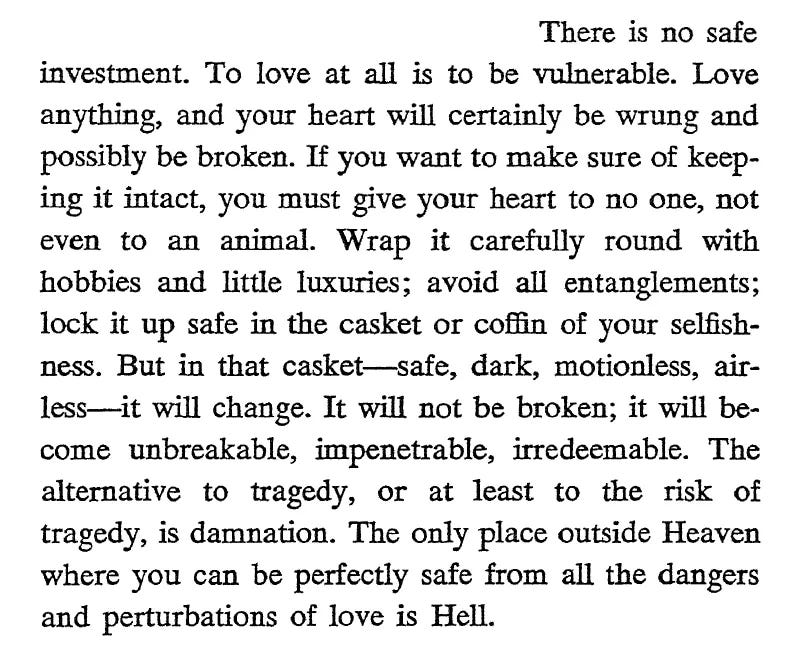
Familiarity can create the illusion of knowledge without requiring the labour of knowing. I can recognise your patterns without understanding what they mean, and know your entire history, and still fail to encounter your subjectivity.
What brings many couples into therapy is often self-described as a ‘communication’ problem. They cannot talk without fighting, they repeat the same arguments, one withdraws, and the other pursues, one criticises, and the other becomes defensive. These are not the symptoms of faulty ‘communication.’ There is something far more fundamental taking place. Words I have heard countless times in the therapy room include “unheard”, “misunderstood”, “unseen”, “gaslighted” etc. All of which attempt to convey to me that they feel the reality of their subjective experience is being, on some level, negated by the other. They have stopped relating to one another as subjects. Instead, each partner begins to relate to the other as an object within their own psychological world, a projection of sorts. My husband quits being a person who might have an experience I do not yet understand, and is simply selfish, and my wife is no longer someone whose withdrawal might have a meaning I have not yet grasped, she’s just cold. Each person becomes increasingly certain that they know what the other is, while becoming less capable of discovering who they actually are. This is referred to as subject-to-object relating.

At this point i want to discourage anyone from thinking of ‘objectifying’ another person as simply bad. We are always turning other people into objectified extensions of ourselves to some degree. It is part of how the mind works.We have to make internal representations of other people in order to remember them, to anticipate them, and to navigate the world they happen to live in along with us. The problem is not that I have an image of you or a representation of you. The problem begins when my image of you becomes more real to me than you are.
Then the other person’s subjectivity can quite easily become an irritation. You tell me what you feel, I explain why you feel it. You tell me that I have hurt you, and instead of becoming curious about your experience, I mobilise a defence against the accusation. Your interiority becomes something I have to manage rather than something I want to encounter. The relationship becomes a struggle between competing interpretations.
Here is where ‘communication’ breaks down, or rather has no use. Not because the couple lacks language or vocabulary, in fact, we often say far too much, but because each partner has lost the capacity to tolerate the other’s mind as genuinely and interestingly other in its own right.
Subject-to-subject relating asks of us something really quite difficult. It requires me to accept that there is a mind in front of me that is not an objectified extension of my own. That you are the main character of your own life, just as I am of mine. You may experience the same event entirely differently from me. You may remember it differently. You may want something I do not want. You may be hurt by something I never intended to be hurtful. You may even see something about me that I cannot yet see about myself.
Fundamental Attribution Error is one of the many inherent obstacles to our capacity to engage with the other as a subject. It is a cognitive bias that allows me to acknowledge my complexity and nuance, while disabling me from offering others the same understanding. I am elaborate and complex; you are simple. If I am in a bad mood and yell at my partner, it is a result of a plethora of contextual factors (there was traffic on the way home, I have late assignments due at work, etc.), but if my partner is in a bad mood and yells at me, it is because they are simply and reductively rude.
To recognise you as a subject is therefore to relinquish a sort of relational omnipotence and a very real kind of narcissism. I cannot simply decide what you mean and what you are.
This is why establishing intersubjective recognition is the first step in any decent couples therapy. Intersubjective recognition does not mean agreeing with everything the other person says, nor does it mean surrendering or compromising one’s own subjective perspective. Quite the opposite. Recognition requires two subjects. I can disagree with you and still recognise that your experience is real. I can say, ‘I did not mean to hurt you’, without implying, ‘therefore you were not hurt’. I can defend my intention without erasing your experience. There is a world of difference between being understood and being recognised. Understanding suggests that I have sort of figured you out, whereas recognition often begins with the admission that I have not.
Good couples therapy is, therefore, less about teaching two people how to ‘communicate’ than it is about helping them become genuinely and actively curious about one another again. However, admittedly, there is another paradox here, because subject-to-object relating is not something we should attempt to abolish.
Particularly when it comes to sex.
Sexual desire always has an object. We desire someone and become fascinated by face, body, voice, and the very little of themselves they give us at first. We fantasise and project and imagine, and we temporarily allow the other person to occupy a place in our psychic world that is different from the place they would occupy at the breakfast table. There is something fundamentally objectifying about erotic desire, and that is not necessarily a pathology.
In fact, a wholehearted flat adoption of subject-to-subject relating can itself become strangely antiseptic when applied to the erotic life of a couple. Another common complaint that often develops into a rich sequence of couples therapy sessions sounds something like this: “I love my wife. We rarely have explosive arguments, and when we do, they are meaningfully repaired. I respect her, I remain interested in her, and yet our sexual life has all but disappeared.” I have narrated this complaint from the perspective of a man because, in my experience, this particular dilemma is often more vocally expressed, and perhaps more acutely felt, by the male counterpart in a couple. This member of the couple has successfully come to perceive the other as a subject: as a person with an interior world of their own, and as a simultaneous main character of their shared story. Yet the very achievement of this subject-to-subject relating can make the movement into sex, into erotic objectification, feel degrading or even incompatible with the individual’s relational attitude towards her.The individual struggles to hold the partner simultaneously as a subject whose subjective experience of life they deeply respect and as an object of their own desire.
Sexual desire does not particularly thrive under conditions of perfect relational democracy, equality, and complete psychological mutuality. There is something about eroticism that requires asymmetry and the freedom to experience the other as an object of our fascination. Esther Perel has written about this paradox:2 that desire and attachment do not cooperate easily. The person I feel safest with is not automatically the person I most erotically desire. Which is often one of the many forces that underlie the impulse for infidelity.
Therefore, it would be a mistake to imagine that the mature couple should eventually arrive at a state in which every aspect of their relationship is governed by intersubjective recognition. There is a necessary oscillation between our being subject and object. Sex is one of the places where this becomes most visible. In erotic fantasy, we can objectify and be objectified, be the desirable source of pleasure, and be the desiring pleasured. We can become temporarily less interested in the whole psychological person and more absorbed in a particular sensation, fantasy, or role. The ordinary self can loosen its grip. We can become less civilised and less predictable. There can be aggression, surrender, selfishness, exhibition and concealment, dominance and submission. The erotic imagination gives parts of the self permission to exist that ordinary attachment, or our history of attachment, may encourage us to keep hidden.
I don’t intend to imply here that every fantasy should be acted upon, nor that objectification is harmless in every context, not at all. I mean only that the object dimension of desire has a legitimate psychological function. Lust can sometimes tell us something that our more respectable superego-coded forms of consciousness have forgotten. We tend to imagine that when we desire another person, we are responding simply to who they are. But often, we are also responding to who we become around them. Something in the other permits a version of ourselves to emerge. Perhaps a version that has been historically rejected and repressed. In sex and in sexual desire, we all, at least some of us some of the time, if not most of us most of the time, use the other as a kind of vehicle transporting us to an unfamiliar region of our own psyche. As a result, eros has a powerful allure. We think we are pursuing the other, however, we may also be pursuing some lost or disavowed part of ourselves.
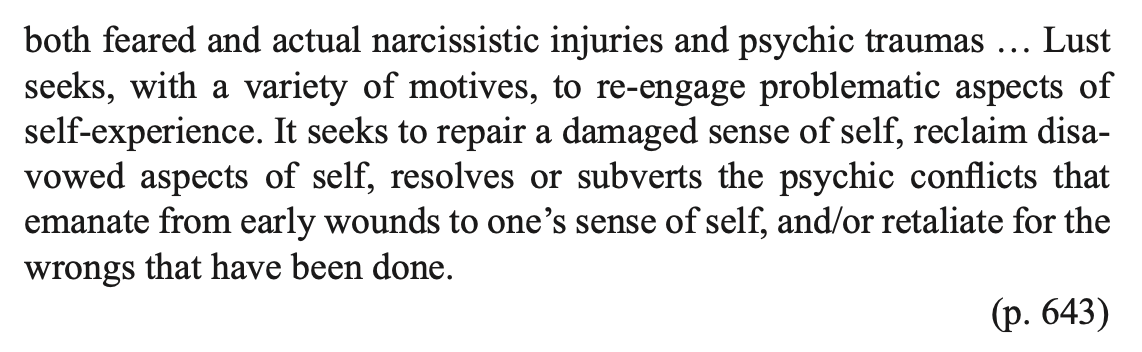
Eros and lust seem to provoke a reparative venture to the ruptures caused within a person by their very own developmental attachment system, which is, of course, most commonly our family of origin.3 The person who excites us may embody freedom, play, power, or vulnerability that we have difficulty accessing on our own. Desire is therefore not simply acquisitive. It can be revelatory. It shows us something about what we are hungry for and also something about what is missing from the self. As a result, long term relationships are often incredibly psychologically demanding. The partner is asked to occupy contradictory positions.They must become familiar enough to provide attachment and remain ‘other’ enough to sustain Eros, known and unknowable at once, safe and yet still surprising. It is really no wonder couples struggle.
I don’t think the question is whether love can reconcile these contradictions once and for all because perhaps it cannot. The better question is whether two halves of a couple can learn to live inside them and oscillate between them with a degree of freedom and curiosity, in and out of the bedroom, without destroying one another. Or as Perel puts it, it is “a paradox to be managed, not a problem to solve”.
The kryptonite of Eros is not the absence of sex. It actually may be certainty, or rather the illusion of it. When I am certain that I know you, there is very little left to discover, and when I am certain that I know what you mean, curiosity becomes redundant. When I am certain that your behaviour can be explained by the role I have assigned you, you cease to surprise me. And when you cease to surprise me, something in the relationship begins to die.
The work of love, therefore, involves learning how to encounter the familiar as though it were still capable of revealing something unknown, because it always is. The partner who sits across from us at breakfast today is not the same person we first kissed. Nor are we. Five years can completely remake an individual, new interests arise, old interests die, identities shift, worldviews expand, or unexpected ambitions take root. It is not in the nature of a human being, or anything else for that matter, to remain the same across a lifetime. ‘The only constant is change’, as Heraclitus put it. There is always more to discover.


Mitchell, S.A. (2002) Can Love Last? The Fate of Romance over Time. New York: W.W. Norton.
Perel, E. (2007) Mating in Captivity: Unlocking Erotic Intelligence. New York: Harper.
Frommer, M.S. (2006) ‘On the subjectivity of lustful states of mind’, Psychoanalytic Dialogues, 16(6), pp. 639–664.
Everything I have failed to articulate articulated in your article. Everything I wish to say said with the right word and the right intellectual curiosity and no shame of the obvious we ignore or fail to understand.
I want to thank you on your writing, and I hope more will come.
Thank you for sharing this incredible piece!
I was particularly touched by the line “Once I believe I know you, I can stop looking for you”. It is an important reminder to keep relearning a partner at each stage of life; I think there is always so much more to discover within someone else’s world if we are willing to look beyond our own for a second.