

Colonisation is as Much a Psychological Project as it is a Political One
Fanon's Theory of Oppression & Liberation Has Never Been More Relevant

Colonialism establishes itself in violence and survives by refining it. This is well established and has been documented by minds far greater than my own. However, there is a kind of colonial violence not immediately visible. A violence that doesn’t mutilate and disfigure the bodies of its victims, but disfigures the mind. Frantz Fanon, the psychiatrist and anti-colonial theorist from Martinique, understood this better than most. Fanon is, in my opinion, the most compelling thinker when it comes to understanding the psychological fallout of colonialism. He uniquely sits at the intersection of psychology, politics, sociology and lived experience, and his writing reflects this. Reading Fanon is not just an intellectual exercise for me; his writing feels deeply & intimately personal. On the one hand, as a psychotherapist, I recognise the psychic wounds he so vividly describes, and on the other, as someone who is a member of the Iraqi diaspora, I’ve seen and heard those wounds firsthand. They show up in the faces and stories of people in my own community: the fractured identities, the shame, the efforts to find belonging in places that have systematically told them they don’t belong.
Fanon’s ideas resonate so deeply because they’re not abstract. They are foundationally reflected in Gaza, Lebanon and Yemen today and psychologically evident in the narratives manifested in therapy rooms, classrooms and Mosques.
‘colonisation of the mind,’
Fanon’s central and most insistent idea is that colonialism is a psychological project as much as a political one. This is unequivocally true. He spoke extensively of the ‘colonisation of the mind,’ a process where the coloniser imposes not just practical systems of control but also, through language, imagery, and branding, manufactures a worldview that reshapes how the colonised person perceives themselves. It is a rebranding of a population’s sense of self and identity. And when that manufactured worldview is internalised, it becomes a kind of psychological captivity. I’ve seen this in members of my Iraqi community who have lived under authoritarian regimes (e.g. Saddam Hussein), Western occupation, or violent displacement. The physical violence of war is obvious, but what’s less visible is the engineered narratives that accompany the violence and suffering. The internalised shame and inferiority, the deep-seated belief that our languages, customs, and even our emotions are somehow “less than.” Fanon deeply understood how the oppressed are forced to view & understand themselves through a lens that was created by their own oppressors.
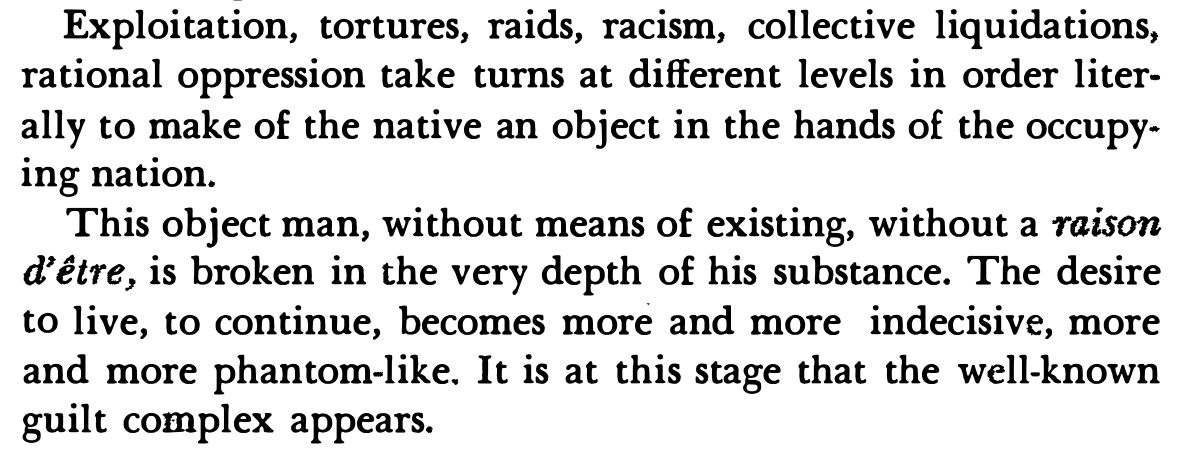
What Fanon makes brutally clear is that this psychological conquest does not emerge in isolation from material violence; it is produced through it. He catalogues the exploitation, torture, raids, and systematic racism not as incidental abuses but as coordinated techniques that operate at different levels and in alternating sequences in order, quite literally, to make the native into an object in the hands of the occupying power. Violence here is not only punitive but formative. It disciplines perception, trains expectation, and teaches the colonised subject their supposed place in the world. Through repeated exposure to arbitrary force and racialised domination, the native is stripped of agency and reduced to something acted upon rather than acting.
The colonised person becomes an ‘object man’. A person without the means of existing and without a socially recognised raison d’être (reason for being). It is an ontological assault, a breaking “in the very depth of his substance.”
‘black skin, white masks’
In a commentary on the subsequent stages of colonisation, Fanon unpacks what happens when the oppressed population attempts to assimilate & integrate into the dominant culture that fundamentally devalues them. He describes the psychological contortions one must put oneself through to “pass,” to be palatable, to be acceptable, to be safe. I’ve witnessed these dynamics in the way some in my community change their names or the pronunciation of them (‘Mohammad’ becomes ‘Mo’), suppress their accents, avoid speaking Arabic in public, or feel discomfort and an awkwardness around their own traditions.
It’s heartbreaking, but it makes absolute sense. When a society associates your cultural identity and native features with backwardness or violence or death, it becomes a survival strategy and necessity to disassociate & distance yourself from it. Fanon didn’t blame the individual for this impulse; he understood it as a largely unconscious symptom of a greater sickness. I’ve personally seen the emotional cost of these masks: the confusion, the alienation, the apologetic tone, the longing for wholeness.
These internalised colonial narratives don’t just distort identity, they actively stifle the capacity for resistance. When self-preservation within the dominant culture becomes the primary goal, especially in environments steeped in racism, Islamophobia, or xenophobia, the self begins to adapt in ways that prioritise safety and belonging over authenticity. This adaptation, code-switching, self-erasure, and disavowing one’s heritage, can feel necessary and even reasonable. But over time, it dulls the impulse toward autonomy. The colonised subject begins to believe that full participation in the dominant system is the only viable path to safety or acceptance. And when the cost of resistance is perceived as exile, villainisation, ridicule, or violence, resistance itself does not feel like an option. The self doesn’t just submit; it dissolves. Agency is not so much taken away as it is traded for the illusion of survival. In this way, the colonising force doesn’t need to enforce obedience through violence alone because the mind, once fully colonised, polices itself.
‘psychic eruption’
When consciousness is reached, however, what Fanon describes as a Psychic Eruption takes place in the minds of the colonised. By the time Fanon wrote The Wretched of the Earth, his tone had shifted. Living through the oppression and brutality of the Algerian War, he began to speak of violence, not as a romantic ideal, but as a kind of psychic rupture. For the colonised, violence became not only justifiable political rebellion; it was a necessary psychological release, a fracture of the manufactured identity they had internalised. A desperate reclamation of humanity in a system designed to erase it. I’ve worked with people who carry generations of trauma, who’ve never had the space or language to express their rage or pain. That unprocessed rage and hurt doesn’t vanish, it is expressed or festers within, and when it inevitably breaks its shell open, it is demonised by the oppressors that created it and labelled as inherently ‘evil’ and ‘terroristic’. Fanon recognised this long before it became mainstream to talk about ‘intergenerational trauma.’ He saw that healing sometimes starts with breaking the silence, even when it is the silence that has kept you safe.
Fanon’s thesis here was described almost perfectly by a Palestinian prisoner in his twentieth year in captivity:
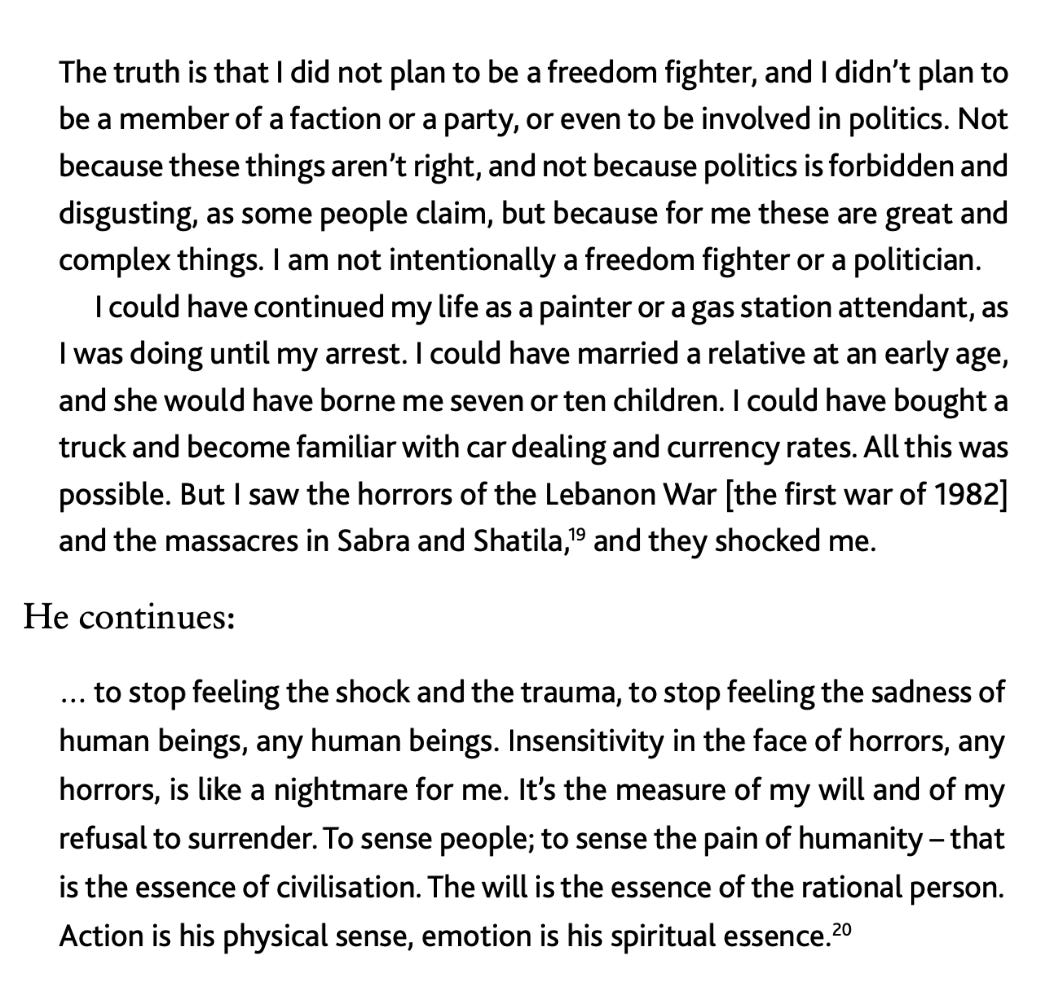
‘she who sees without being seen frustrates the coloniser’
What a line. In a world that necessarily commodifies women’s bodies, reducing their value to sexual visibility and desirability, the hijab is perhaps the most disruptive anti-colonial symbol. It is a conscious refusal to let a woman’s worth be defined by how consumable she is. Fanon, after his time in Algeria, understood this. The hijab creates space for a woman to reclaim and uphold inherent value, to exist with subjectivity intact. You do not get access to me unless I choose to grant it. In colonial contexts, where the visibility of Muslim women was often politicised and used to signal ‘progress’ or ‘liberation,’ the hijab became threatening because it symbolised absolute autonomy and a resistance to being read and redefined. In this sense, the hijab is an act of radical self-possession. It frustrates both the coloniser and the capitalist logic that ties a woman’s value to her sexual currency. She sees, but she is not automatically available to be seen. And in that refusal, there is agency.
‘disalienation’
One of Fanon’s most beautiful and radical ideas is disalienation, the process after psychic eruption of reconnecting with a self that was systematically denied. He believed that psychological liberation comes when we stop measuring ourselves by colonial standards, when we begin to author our own stories again. In my work, I often witness this transformation, slow and painful, but deeply moving. I’ve seen clients reconnect with their heritage, reclaim their mother tongue, or begin to love the parts of themselves they were once compelled to hide. This isn’t just ‘empowerment’; it’s identity reconstruction. It’s psychological healing at the deepest level. Fanon spoke of creating ‘new men,’ but I don’t read that as a call for perfection. I see it as a call for courage & authenticity. A call to become someone who is no longer alienated from their roots, their body, their history, or their worth.
Fanon’s work continues to echo painfully in the present, and nowhere is that more evident than in Palestine, especially in Gaza, where we are witnessing not just a military occupation but a systematic attempt to annihilate and erase a people’s presence, memory, and narrative. Yet, despite the devastation, what we also see is a radical form of resistance that Fanon would have recognised: the insistence on visibility and dignity on their own terms. Palestinian resistance, in its many forms, is a direct challenge to the coloniser’s narrative. It’s psychological warfare in its truest sense: a refusal to internalise inferiority, to become silent, or to see oneself through the oppressor’s lens. Like Fanon’s disalienation, this is not just about land—it’s about reclaiming the right to name oneself. In the face of genocide, the Palestinian people continue to assert their humanity in the most profound way. Systems of oppression don’t just build walls; they build narratives. And those narratives take root inside us, often without our consent. But they can be challenged. They can be rewritten.
The Settler Keeps Alive in the Native an Anger Which he Deprives of Outlet

Fanon once wrote that “The settler keeps alive in the native an anger which he deprives of outlet.” It wasn’t a metaphorical notion. It was his clinical observation. He was describing what occurs when a biologically grounded and socially necessary human capacity (defensive anger), is deliberately provoked and then structurally immobilised. To enrage, an…
References
Fanon, F., 1952. Black Skin, White Masks. Translated by C.L. Markmann. New York: Grove Press.
Fanon, F., 1963. The Wretched of the Earth. Translated by C. Farrington. New York: Grove Press.
Bulhan, H.A., 1985. Frantz Fanon and the Psychology of Oppression. New York: Plenum Press.
Gibson, N.C., 2003. Fanon: The Postcolonial Imagination. Cambridge: Polity Press.
Hook, D., 2004. Fanon and the Psychoanalysis of Racism. In: D. Hook, ed. Critical Psychology. Lansdowne: UCT Press, pp.113-138.
Said, E.W., 1978. Orientalism. New York: Pantheon Books.
Deconstructing Sadism: Case Studies from Gaza and Iraq

Sadism takes its name from the 18th-century Marquis de Sade, whose writings glorified cruelty as a source of erotic and intimately psychological pleasure. The sadistic temperament is distinguished from its ugly siblings (psychopathy, machiavellianism, and narcissism) in that it is playful in essence. The sadist manufactures pain for his own amusement, f…
Salaams sister and thank you so much for reminding me of the brilliance of Fanon. Studied Fanon’s works at Uni as a student of Social Anthropology which is in its essence a practice of Neo-Colonialism. Years later I was chosen to be a Muslim by our beloved creator. Reading your piece so poignantly brought me back to the essence of why I love my hijab. It’s not just about hiding my hair, deflecting male attention, holding onto my hayah, or representing and preserving my Muslim identity…it’s an extension of Allah’s love that cascades down from the Quran, and eloquently and elegantly drapes me in mercy, protection and infinite love. It’s my ‘piece of cloth’ that I hold onto to keep me connected to Allah swt. And what could be more beautiful than that? Alhumdullilah.
One of the first books one of my colleagues recommended to me to open up my mind to new ideas of de-colonization (which is a process I felt very related to, in a way I didn't expect) was Fanon's "The Wretched of the Earth"... I've been craving to find a book that challenges my beliefs as much has this one did, as it opened up my mind to new historical parallels I had never studied/known before. Loved the deconstruction of his work, and while I agree that it's both psychological and political, I would be even more inclined that it affects more in a psychological sense. Excellent read!